
Research Point 1:
For this research task, I was asked to pick a film, read a book, or look at a comic strip and boil the story down to its most basic elements. I need to understand what is driving this narrative, how is it resolved at the end, and also what genre it is or if it’s an amalgam of more than one. Make some notes on your reflections in your learning log.
To start this research task I wanted to understand what types of story structures there are. I found a site called ‘Reedsyblog’ where I found out there are apparently 7 types of story structures used in books, films, and comic strips. ‘Save the Cat’, ‘Three Act Structure, ‘Fichtean Curve’, ‘Freytag’s Pyramid’, ‘Seven-Point Story Structure’, ‘The Hero’s Journey & ‘The Dan Harmon Story Circle’.
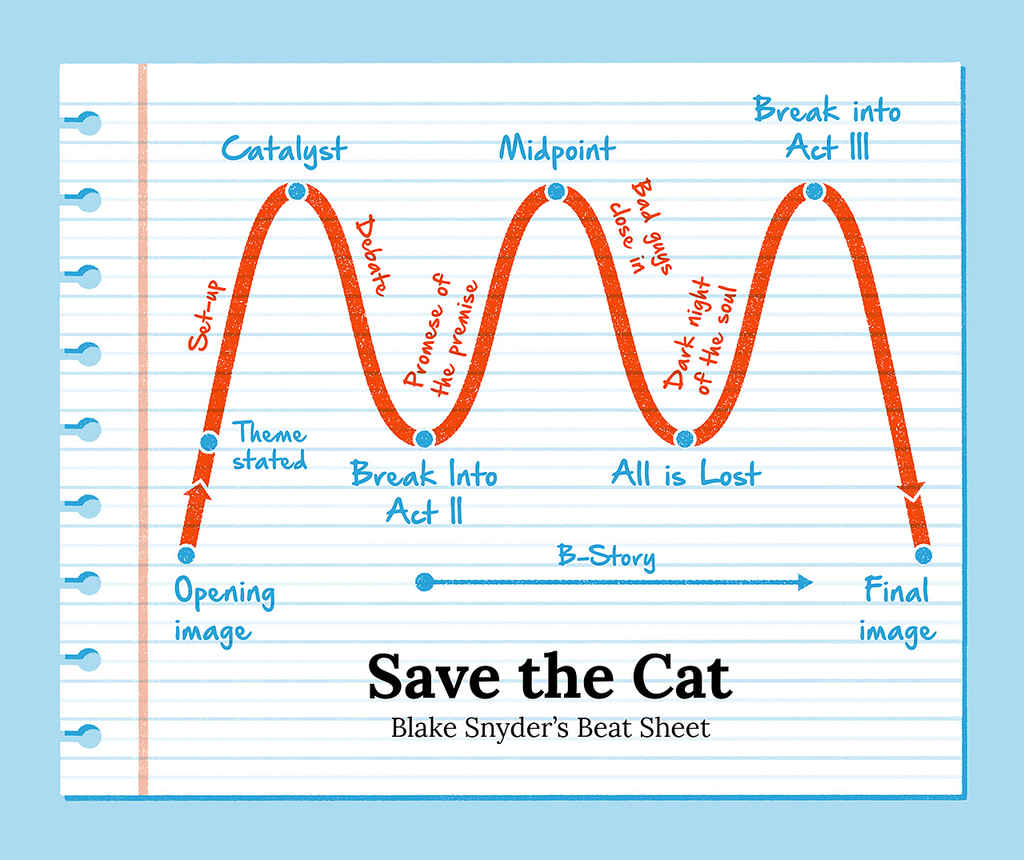
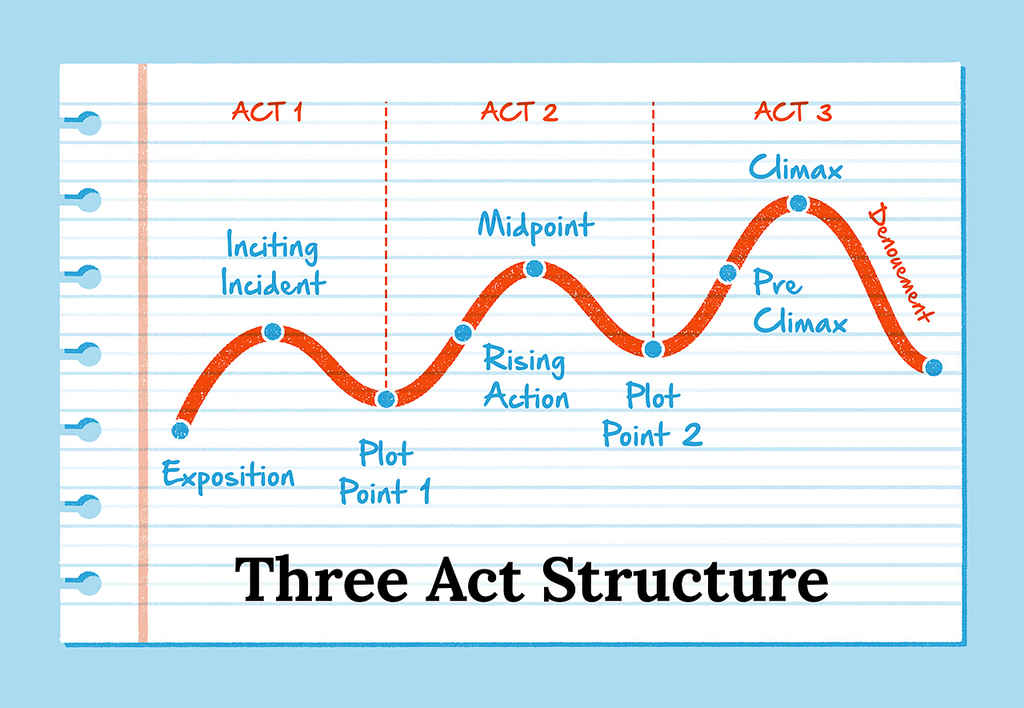
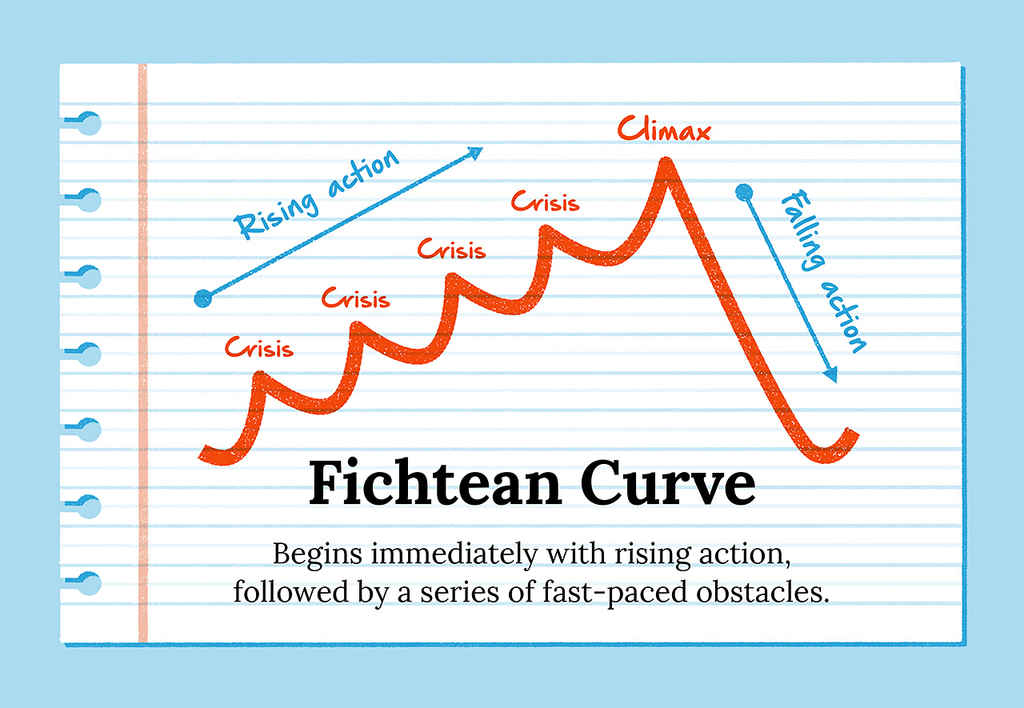
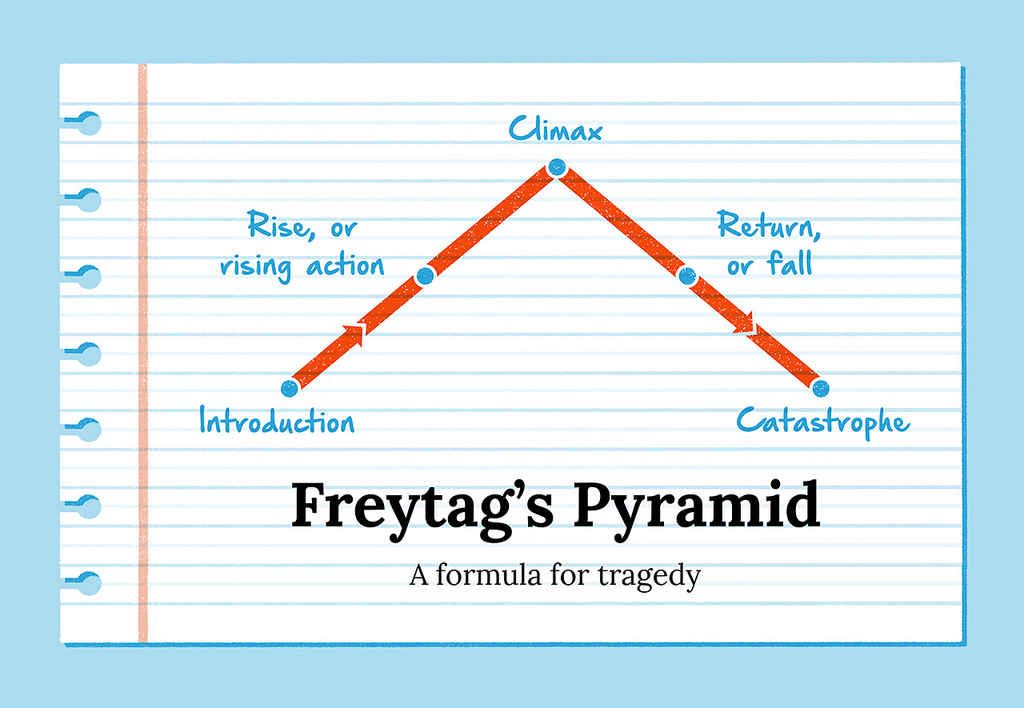
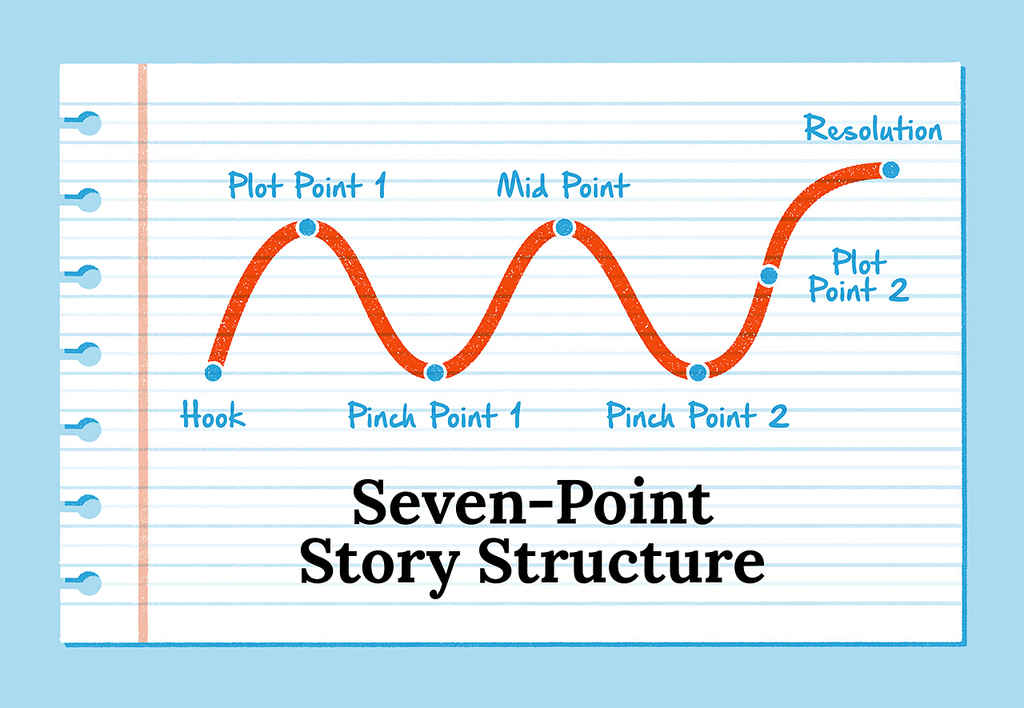
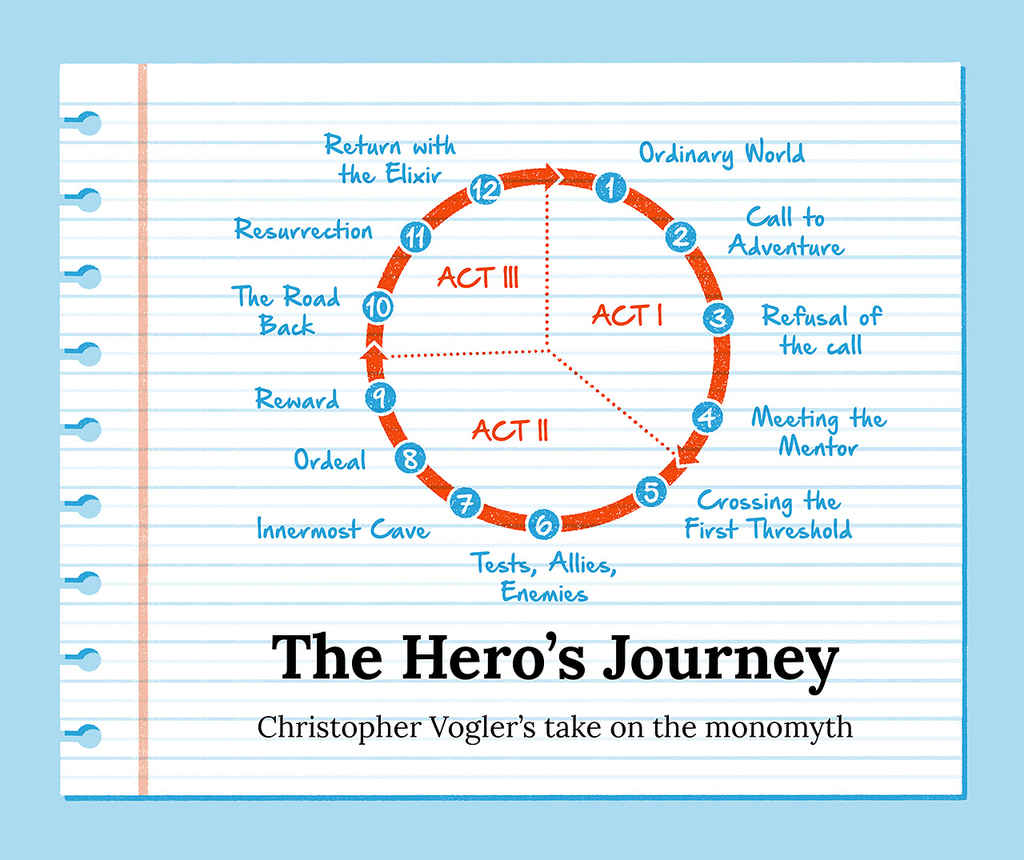
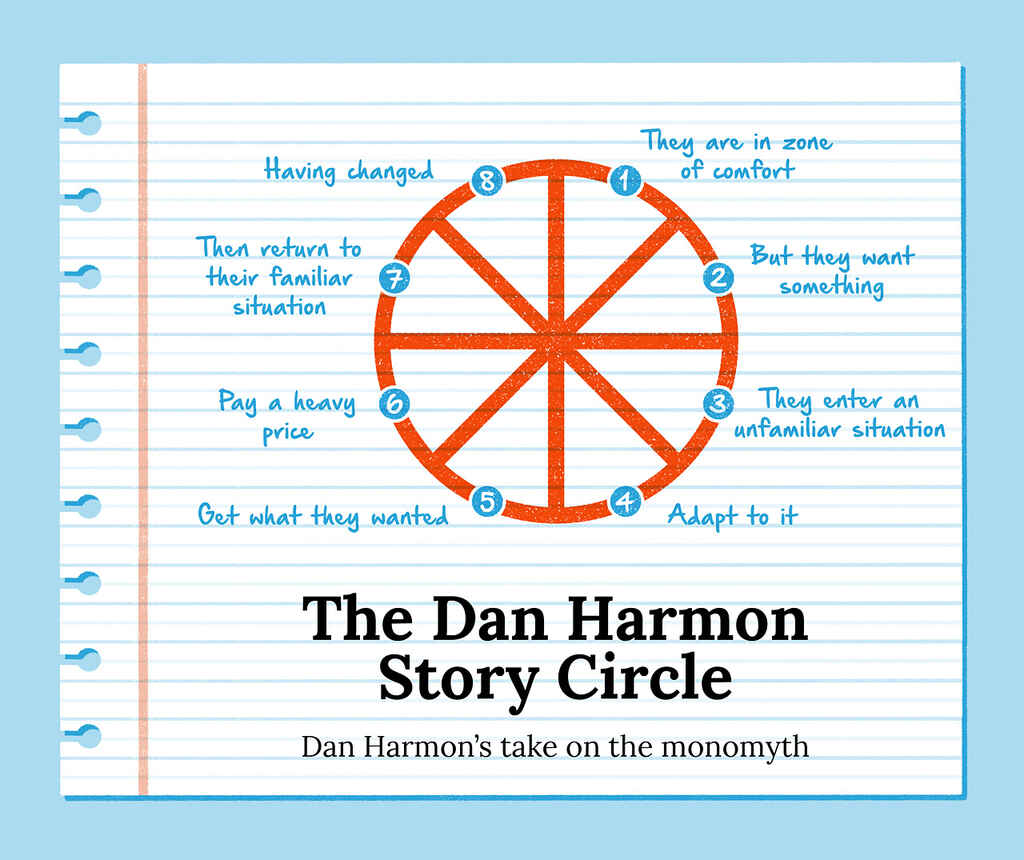
I find it interesting, being a fan of Rick and Morty, that Dan Harmon (one of the two creators/producers of Rick and Morty) created his own story structure, and now after reading this circle above, I can see this being using in almost every episode of Rick and Morty. I think it’s great that he has given his own take and in turn, has created an interesting and unique story structure.
Most of the others out of the seven are quite simplistic, I can see when they have been used in movies, comics, or books but for this research task, I decided to look at an interesting and quite unique film that I think has its own story ‘arc’ or at least an amalgam of a few structures.
Joker (2019)
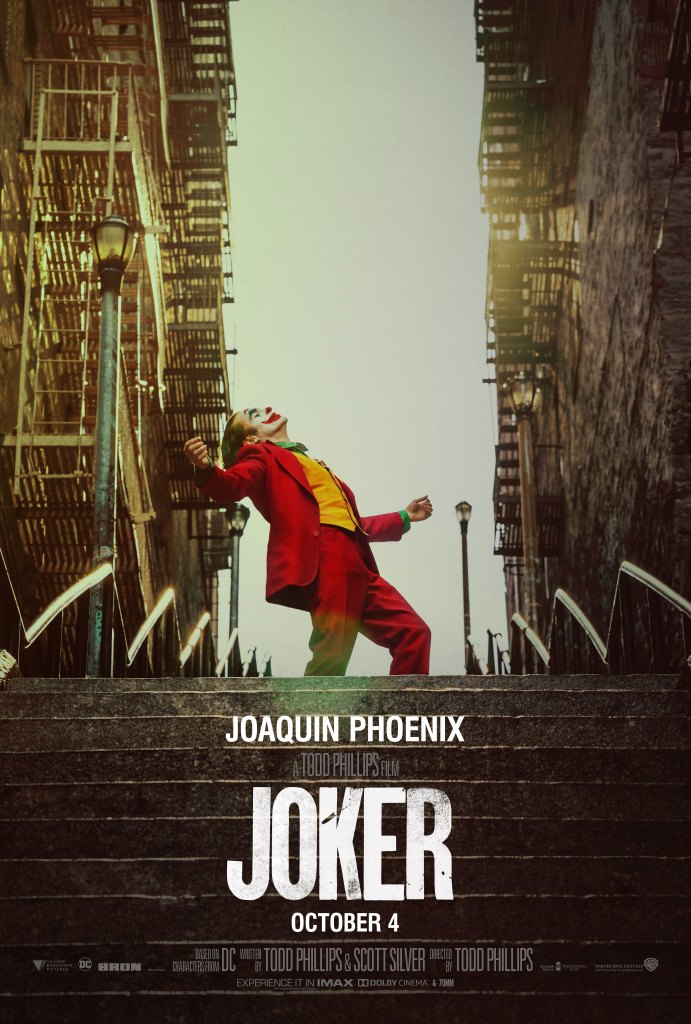
This movie is a psychological thriller. I wouldn’t call the structure of the film linear, it’s ‘non-linear’ as the main character has psychological and neurological disorders which makes us the viewer unsure of what is reality and what are his hallucinations. This movie can make some uneasy due to this dynamic, it’s quite disorientating but this adds to the mental confusion of the main character.
I think the narrative is quite complex as the main character literally wears two masks, one as his day job as a clown and the second as his ‘trying desperately to fit into society with a neglected mental health condition’ mask. So when he decides to take on the personality of the ‘Joker’ both masks collide into the character.
I think this film works so well as you have this deepening sadness for the main character as you understand he has turned into the ‘Joker’ due to the effect of his Mental Health being neglected by a crumbling system, social services. Of course, this rings true more than ever these days, I can relate massively. I think this is a powerful element of the movie as most other supervillain characters are only shown to be ‘bad’ or ‘evil’ due to being the ‘baddie’ in the book, comic, or movie. It’s quite unique to focus on the psychological well-being of the villain.
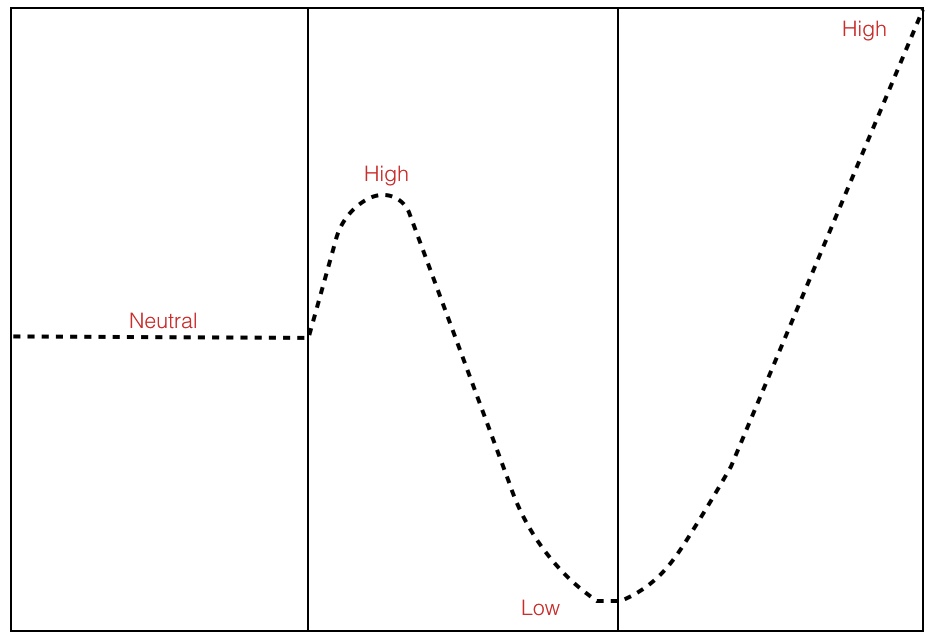
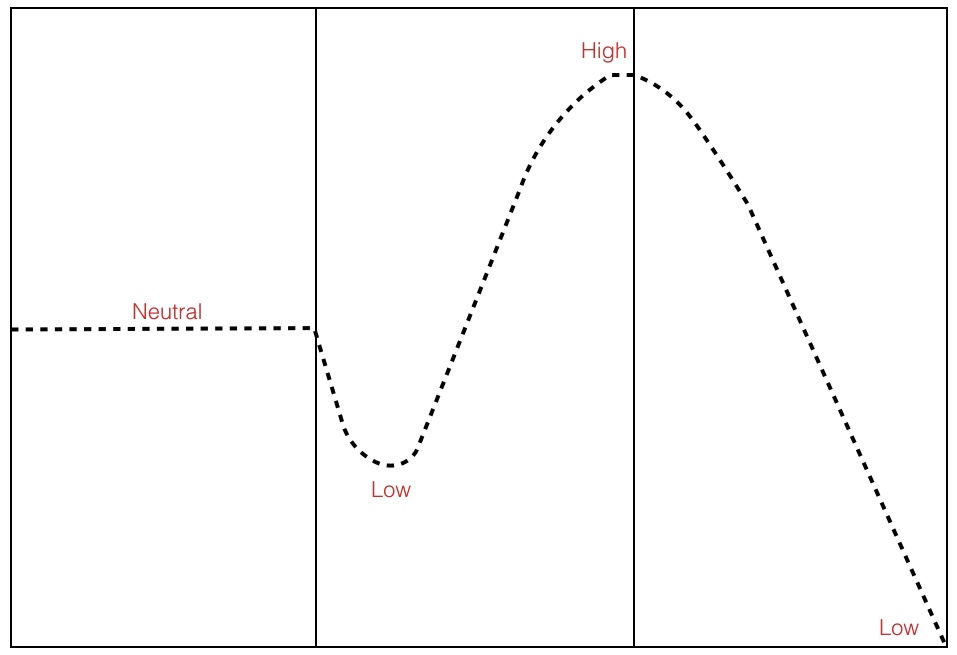
I’d say ‘Joker’ is an amalgam of a few story structures but I think the below best shows it:
The 2 story structure possibilities:
I think this movie is so interesting because in my eyes there are two possible story structures, this is because of the main character’s mental health, so for him, something bad could be good and vice-versa. So a high or low in the story arc could be a good or bad event depending on if the main character is in reality or in the middle of a psychotic episode.
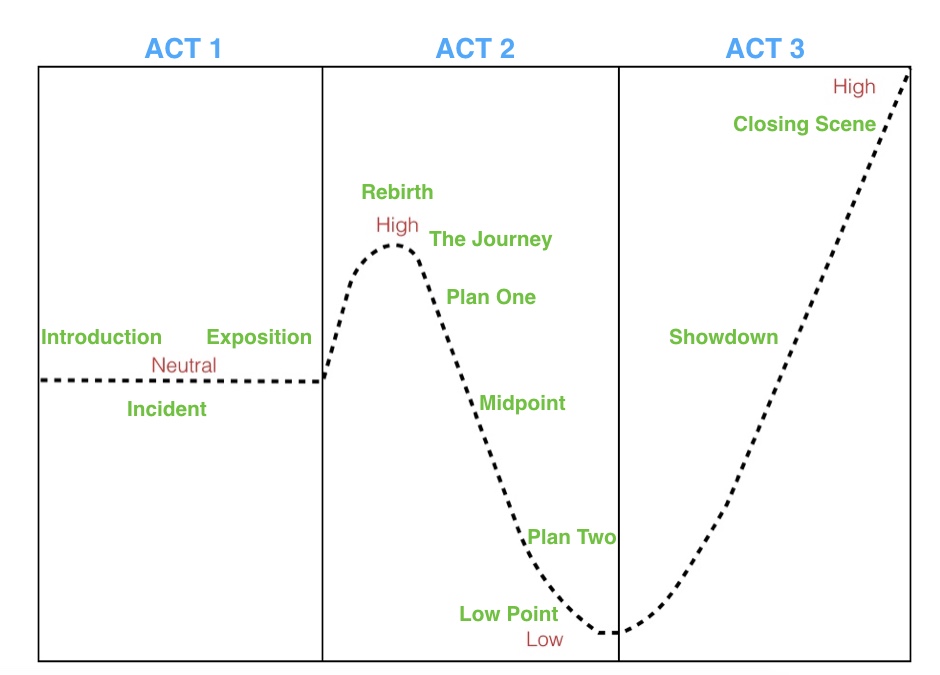
The Neutral, High, Low High Arc:
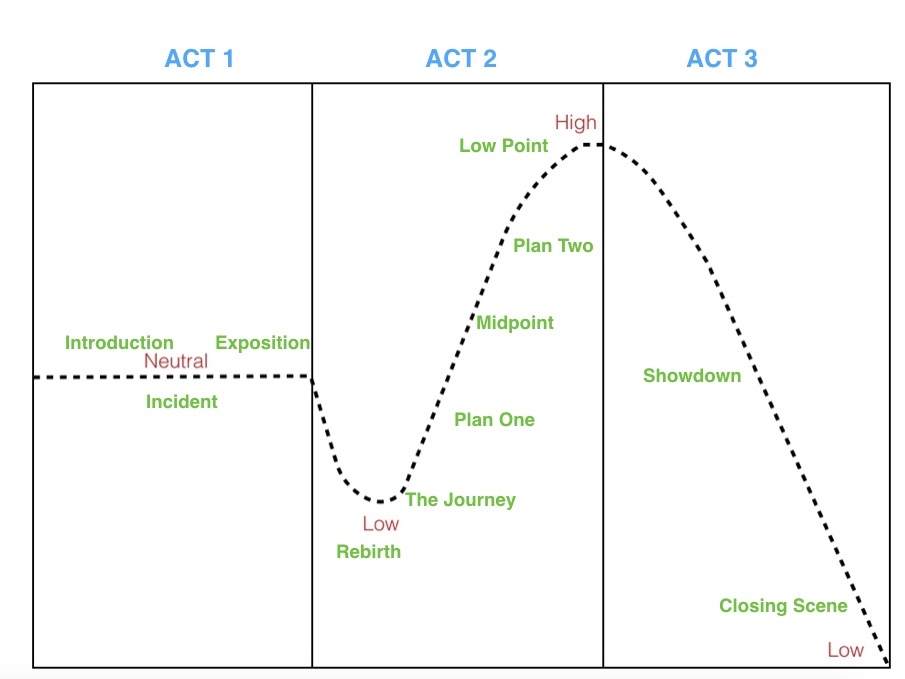
The Neutral, Low, High, Low Arc:
The acts:
Act One:
- Introduction
- Incident
- Exposition
Act Two:
- Rebirth
- The Journey
- Plan One
- Midpoint
- Plan Two
- Low Point
Act Three:
- Showdown
- Closing Scene
Acts in detail:
Act One:
- Introduced to Arther Fleck: Work, Mental Health, Homelife, Family, Lack of friends, Interests.
- Start breaking down, a colleague gives Arthur a gun as he got beaten up whilst on the job the day before.
- He lost his job as he had the gun on him whilst working. Keeps his cool during dismissal but takes out his anger on rubbish in the alleyway, and hurts himself.
- Confides in Mum about his career change and gets shut down by her as she doesn’t believe he can be a comedian.
- Accidentally shoots the gun in the apartment, shocked but exhilarated.
Act Two:
- Arthur tries to protect a lone girl on the subway from three men who are drunk and starting to harass her.
- Arthur has a badly timed laughing fit brought on by the stress of the situation (with the thought that he is too weak to protect her) but when the men aim their aggression at him and attack, he ends up shooting them all with the gun, the confidence and personality changes in an up and down motion.
- The bathroom scene initiates a new start or rebirth for Arthur and the Joker has started to form.
- You are shown Arthur with his newfound confined when he knocks on his neighbour’s door and kisses her.
- Thomas Wayne publicly speaks out about the subway murders and condemns the behaviour.
- Thomas Wayne was previously a father figure who let Arthur down, now he is Arthur’s nemesis.
- Clown vigilante – hero or villain? in newspapers.
- Goes on a date with the neighbour woman, and confidence is shown.
- Does his first stand up, doesn’t go that well.
- Wants to confront Thomas Wayne at his manor house, ends up talking to Bruce, and is asked to leave by Thomas’ butler.
- Arthur’s Mum is in hospital after suffering a heart attack from the police questioning her.
- Arthur’s previous other father-figure Murray Franklin who has a show on TV plays Arthur’s bad stand-up performance clip and humiliates him on live TV calling him a ‘Joker’.
- Arthur confronts Thomas after sneaking into the movie theatre where Thomas is watching a show.
- Arthur confronts Thomas in the toilets, Thomas denies he is Arthur’s father and was in a relationship with Arthur’s Mum, explaining she is delusional and that he was adopted by her.
- Thomas punches Arthur to the floor.
- Murray calls Arthur, he wants him on the live TV show.
- Arthur travels to Arkham Asylum where he finds his Mother’s medical notes explaining that Thomas was right about his Mother being ill and that he was adopted, it also exposes Arthur to the knowledge that his Mother’s boyfriend used to abuse him.
- After Arthur mentally crashes after finding out this information, he goes to his neighbour’s, the neighbour comes out of a room scared to find Arthur in her living room.
- She says they never met and never went on a date, it is apparent with the help of flashbacks that none of it happened, it was Arthur’s hallucinations.
- Mental health takes a turn for the worse, he suffocates his Mum in the hospital.
- Arthur is shown to dye his hair green whilst dancing in his bathroom.
- Arthur kills is colleague when two of them come to visit to see how he is doing, unaware of his mental health deterioration.
- After Arthur has killed his colleague in a gruesome manner, he slumps down in his bloodied pyjamas to the ground and after a small period of fast breathes, calms down and goes on to talk to his other colleague ‘Gary’ about the Murray Franklin show and the fact he is going to be on it. Of course, Gary is mortified and just wants to leave.
- Arthur lets Gary go as he was always nice to him.
Act Three:
- Arthur appears on The Murray Franklin show in full Joker makeup and clothes with a confident exterior.
- Admits without empathy to shooting and murdering men in the subway (but makes a reasonable point!).
- Arthur shoots Murray in the face on live TV.
- Arthur is taken in a police car but Gotham has erupted into mayhem.
- Thomas Wayne and his wife are murdered, leaving Bruce Wayne alone.
- Arthur is seen by the folk of Gotham as a hero.
- Arthur has now fully turned in Joker, personality included.
- Shown being assessed at Arkham Asylum by a mental health worker.
- The scene cuts from Arthur being assessed to Arthur leaving the room with blood on his shoes.
- Arthur is chased by hospital staff.
- End.
Summary:
It’s quite obvious when you look over the three acts which act has the most involvement – act two.
So much happens in the film that it’s hard to narrow down more than what I have already done but if I was to narrow it down to a single sentence it would read:
Arthur Fleck, an isolated and failed comedian enters a slow descent into madness with many traumas along the way before he transforms into the villain ‘Joker’.
https://blog.reedsy.com/guide/story-structure/
https://en.wikipedia.org/wiki/Joker_(2019_film)
Research Point 2:
For this second research task for this part, I was asked to pick some examples of work in comic books, cartoons, and graphic novels that I find interesting. I need to ask what the relationship between the narrative and the style of
drawing being used is? Which is most important in making the story work?
For this research task, I decided to choose 3 graphic novels that I like:
Blacksad – 2012 – Illustrated by Juanjo Guarnido
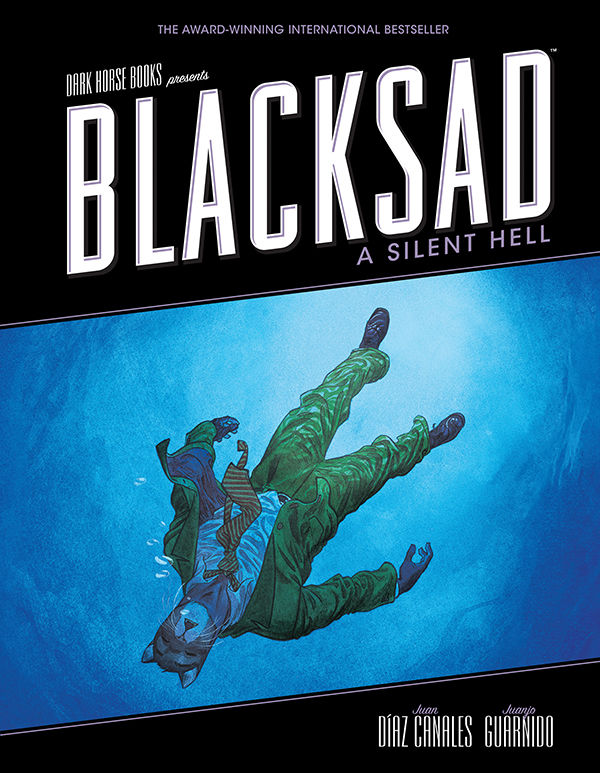
Blacksad is a French comic by Spanish creators Juan Diaz Canales and Juanjo Guarnido. It’s an example of crime fiction with very nice artwork. The characters are anthropomorphic and it’s an interesting way of using animals to express character. There is an interesting mix of styles that resemble old Disney illustrations combined with the aesthetic of a superhero comic. Blacksad is rated for 15 and up due to the details within as well as what the illustrations depict. The plot of the story is about murder so it’s definitely not child friendly. This undertone is best seen through the regular use of violence and graphic nudity. The theme of Blacksad is interracial violence and racial segregation of the 1950s in a pseudo-American suburb. The illustration colours are quite muted showing a sense of sadness and depression, the only parts that show bright colour is when something big is happening or there’s an element that you need to focus on.
Akira – 1984 – Written and Illustrated by Katsuhiro Otomo
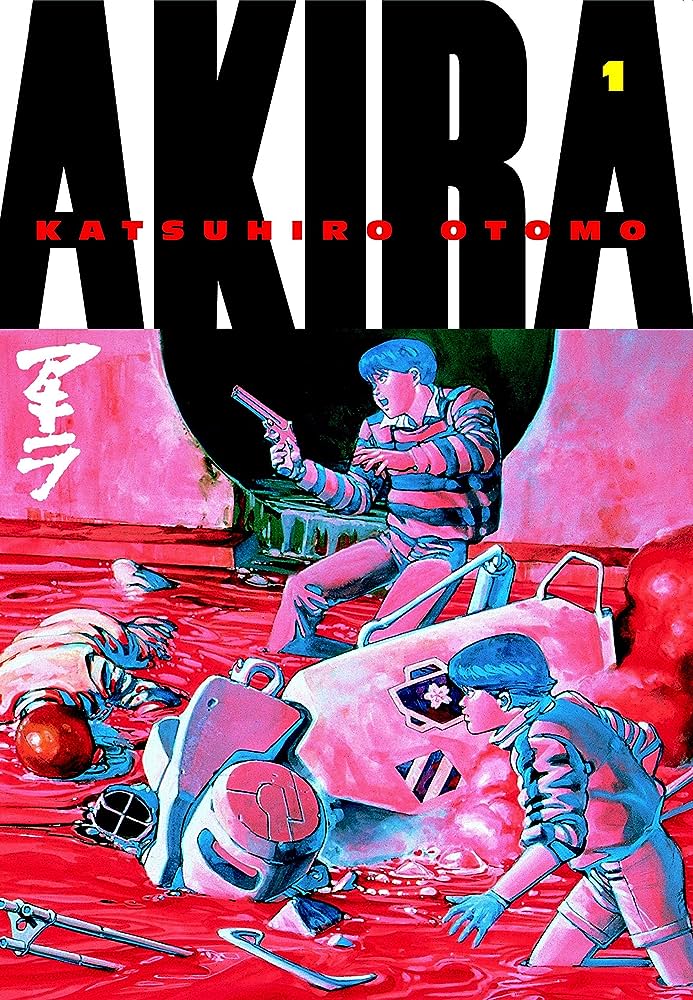
Akira is a Japanese cyberpunk post-apocalyptic manga series created by Katsuhiro Otomo. There is a futuristic feel all the way through the series of manga books. This is shown through the use of bold sometimes neon colours like on the front cover shown above for volume one. This use of bold exaggerated colour schemes is something prevalent in 1980’s Japan in particular as everything was futuristic, and there was a massive want for these types of stories. Also depending on what book you get you can either get the illustrations in full colour or in black-and-white line art only. Either way, both are detailed enough to understand what is being shown in colour or not. The expressions are usually exaggerated but again this is prevalent within manga in general.
Maus – 1986 – Written and Illustrated by Art Spiegelman
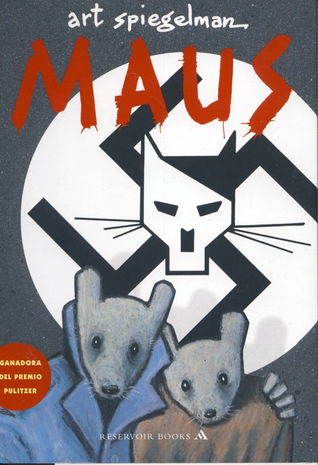
Maus is a survivor’s tale and graphic novel by American cartoonist Art Spiegelman. It tells the story of Spiegelman’s father and shows his experiences as a Polish Jew and Holocaust survivor. Similar to Blacksad this also has characters that are anthropomorphic, but this time the Jewish people are shown as mice. This book really pulls at the heartstrings because you know it’s a true story straight from the mouth of a holocaust survivor and the illustrations are also sorrowful. It’s a dark topic but one that is interesting and it’s a way of getting people to learn more about the holocaust. Apart from the cover art the illustrations throughout are in black and white but this works well with the narrative as it’s a dark and sad story. Also, the black and white works as it is telling a story about what happened to the Jewish people from1939-1945.
Exercise 1: Girl Meets Boy:
For this exercise I will create a sequential illustration that creatively re-tells the story of girl meets boy, girl loses boy, girl wins the boy back, in whatever way you want. I need to think about how I will construct the different twists and turns of the story and decide on how I’m going to draw the characters and action, and how I’ll use the panels, speech bubbles, and sound effects to make the story come alive.
I decided to focus on creating this story using a three-panel comic as there have been a lot of three-panel comics in the past that have been enough to show a full story like the few below:
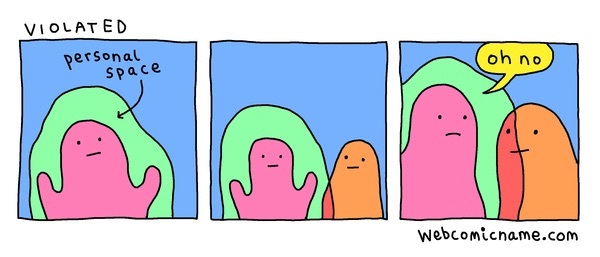
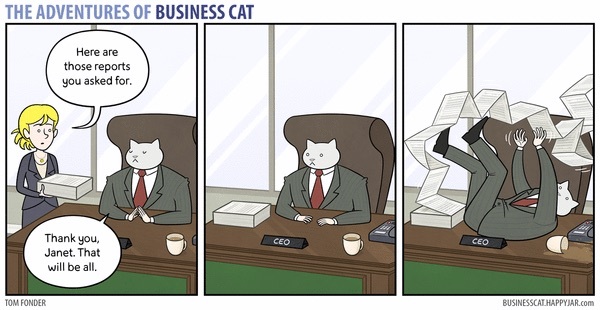
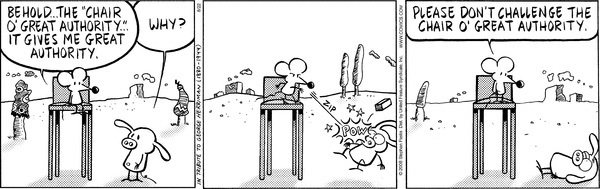
The lack of panels doesn’t mean the stories above are not told properly, the panels can still depict a change in time, action, subject or character, location or scene, and perspective or angle. It depends on the artist but some decide to use speech bubbles and some don’t as you can see what is happening so no speech bubbles are needed. All of the above are humorous I think this is because people want to see something funny in their newspaper or Twitter feed rather than a depressing, matter-of-fact 3-panel comic about cancer or war for instance!
First I need to think about how the three-panel comic works, there are three elements in short: a start, an action, and an ending. This has already been written out for me in the brief of the coursebook:
- Start – Boy meets girl
- Action – Boy loses girl
- End – Boy wins the girl back
I also need to think about character design and their involvement in the story/narrative.
Story ideas:
- Boy meets Girl at school – Bigger boys steal Girl’s attention – Boy has to get buff in order to win Girl’s attention back
- Male bird calls for Female bird – Male bird does mating dance – Male manages to get Female bird through dance, using the below as an example:
- https://www.youtube.com/watch?v=1XkPeN3AWIE
- Boy meets Girl at the beach – Girl gets washed out by tide – Boy rescues Girl from sea
- Boy falls in love with Girl – Girl dies – Boy brings Girl back to life (Frankenstein scenario)
- Boy finds Girl as a prize at a funfair – Another Boy wins the Girl – Boy has to win Girl back one way or another
My chosen idea:
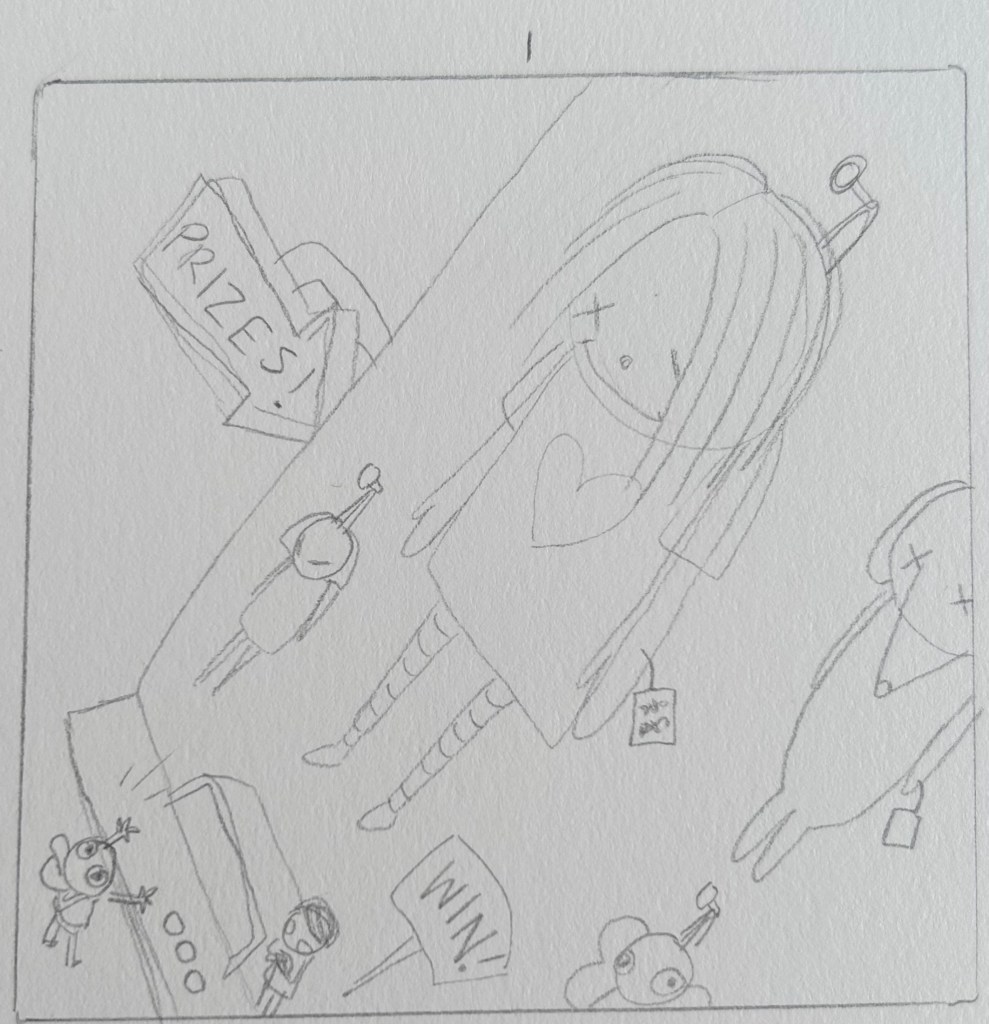
I went with the idea: Boy finds Girl as a prize at a funfair – Another Boy wins the Girl – Boy has to win Girl back one way or another.
Yes, it’s macabre but I wanted to do something different but still tells the story.
Design Process:
Panel layout:
Thumbnail sketches:
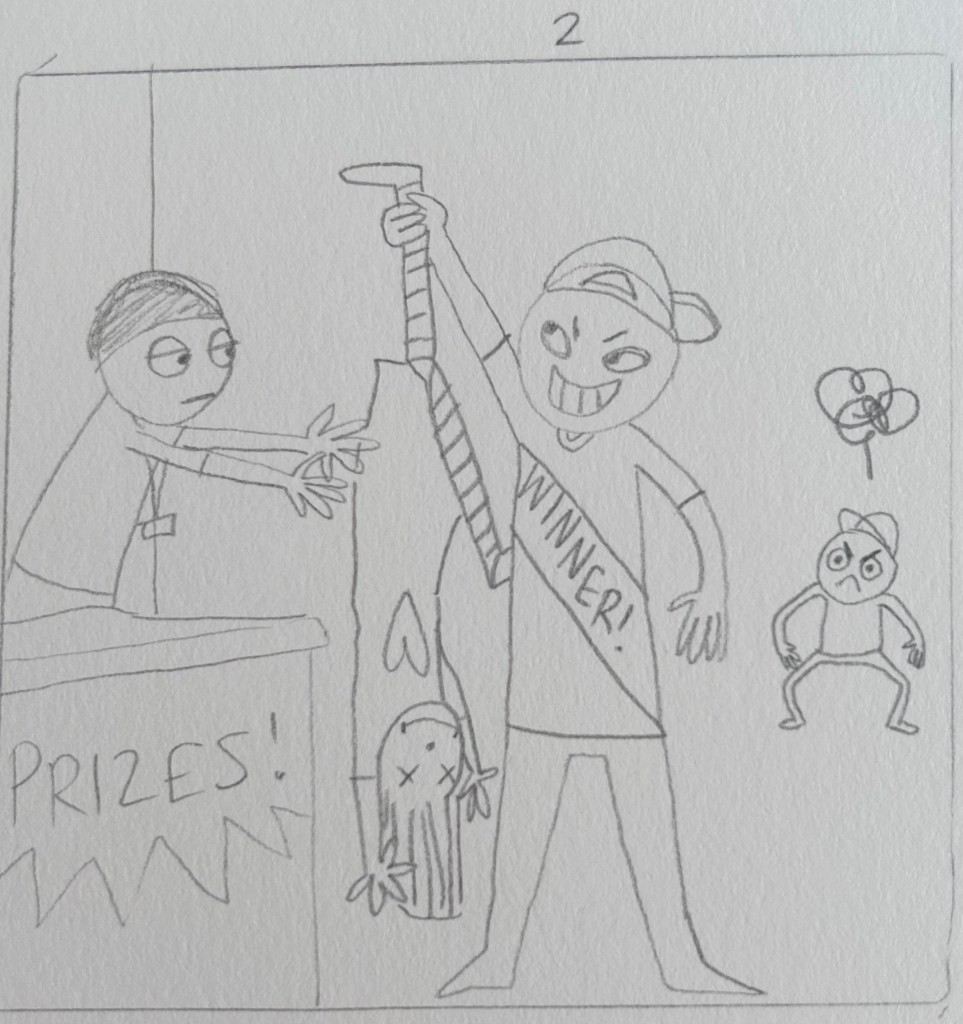
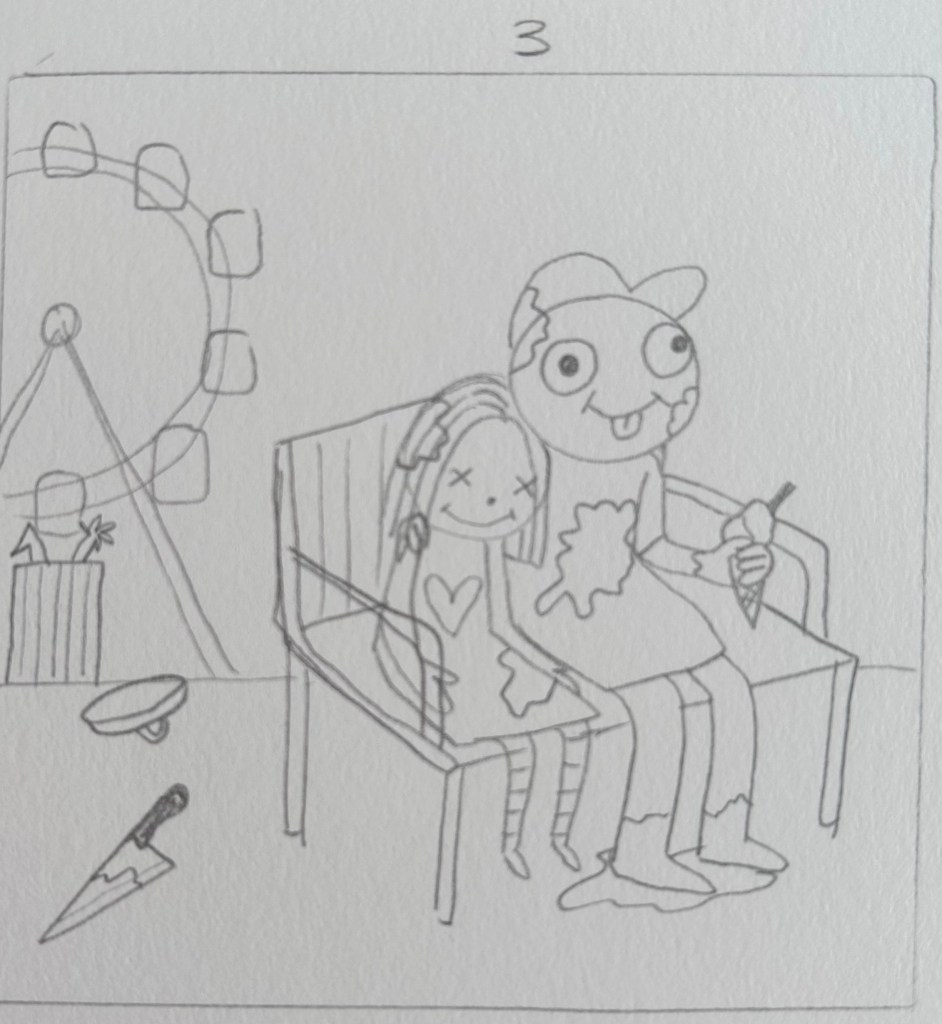
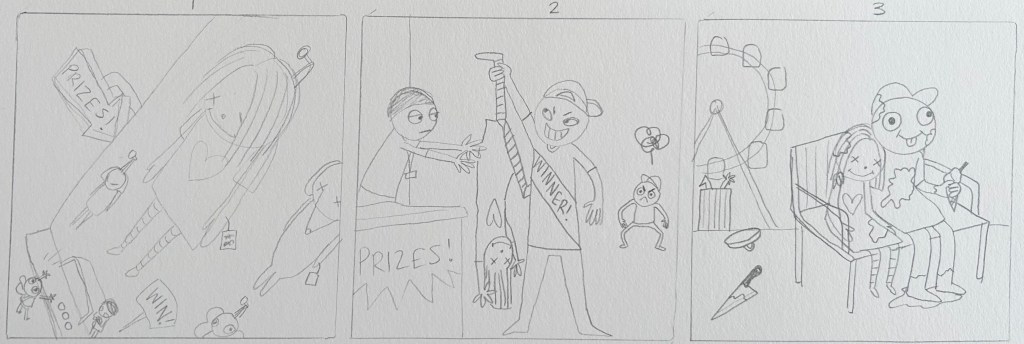
TRACING FROM PAPER TO DIGITAL:
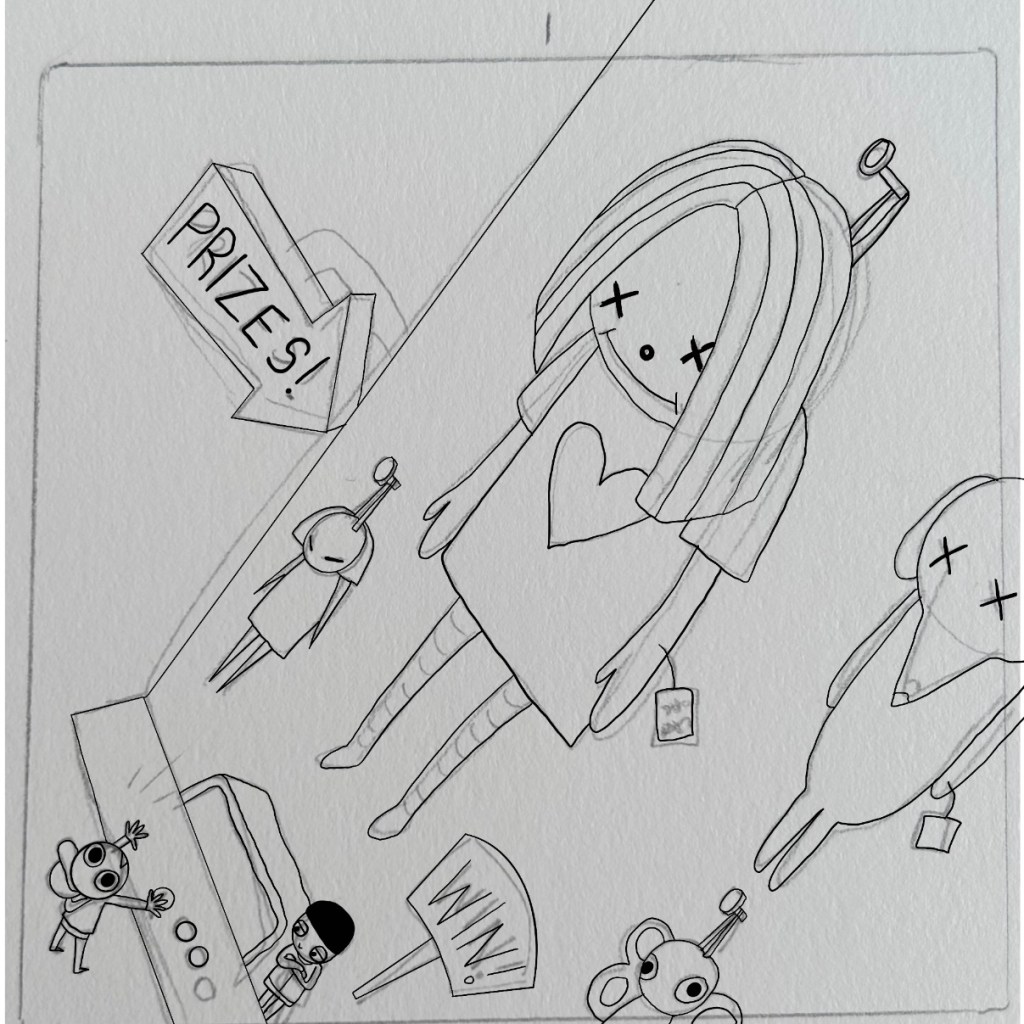
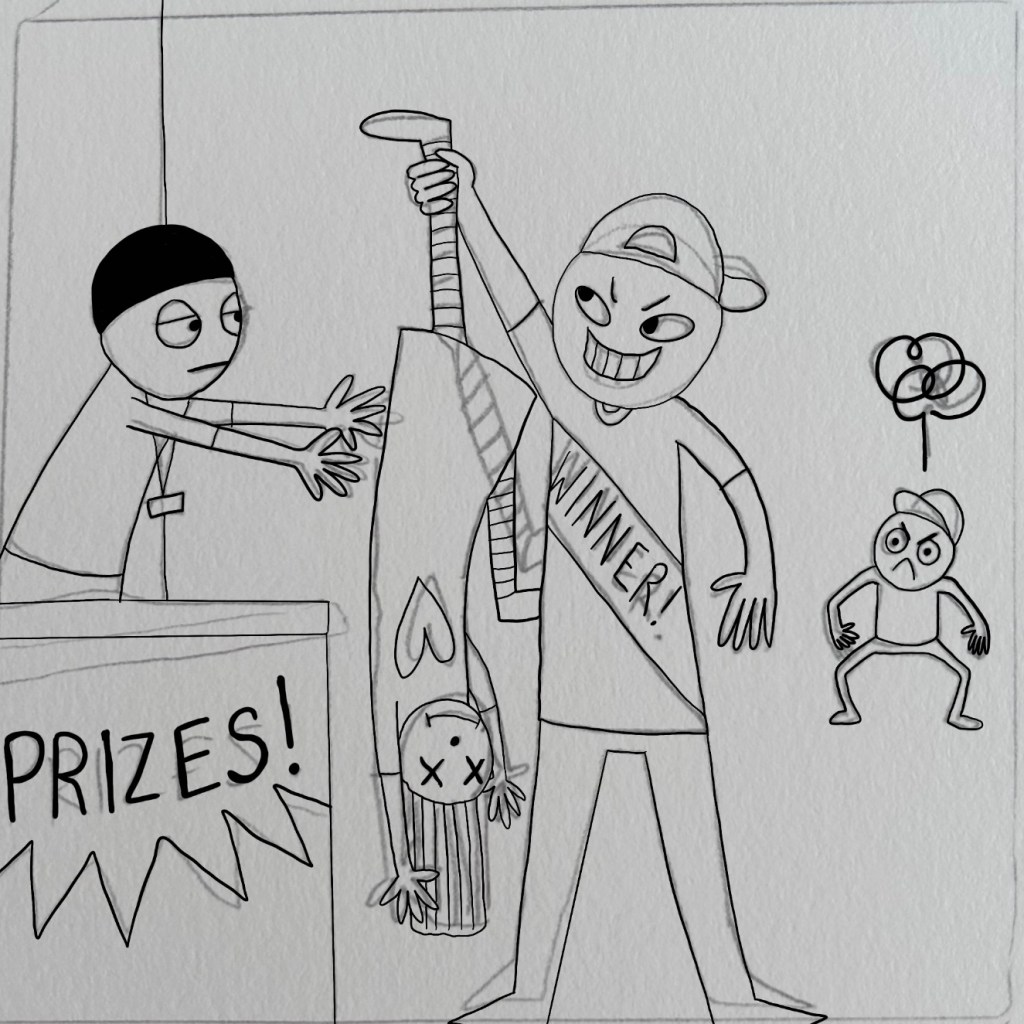
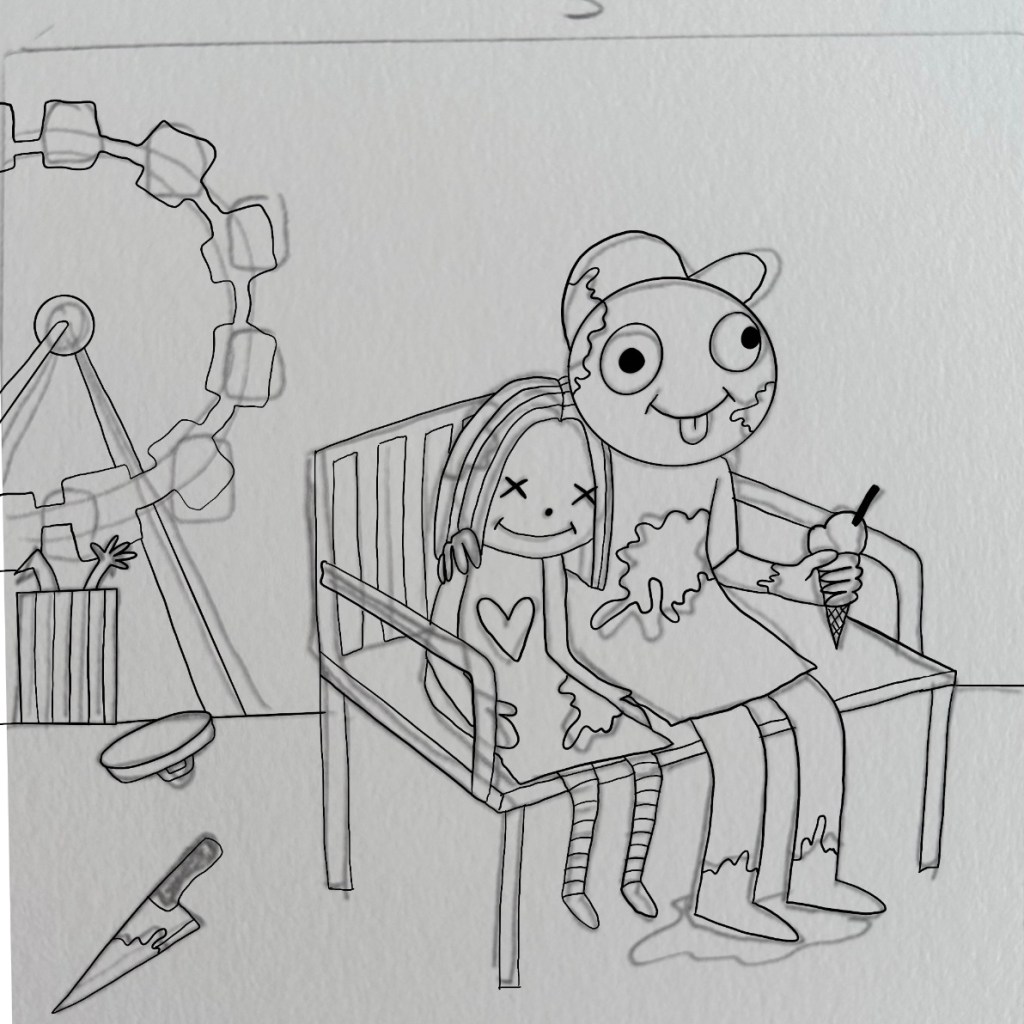
lineart:
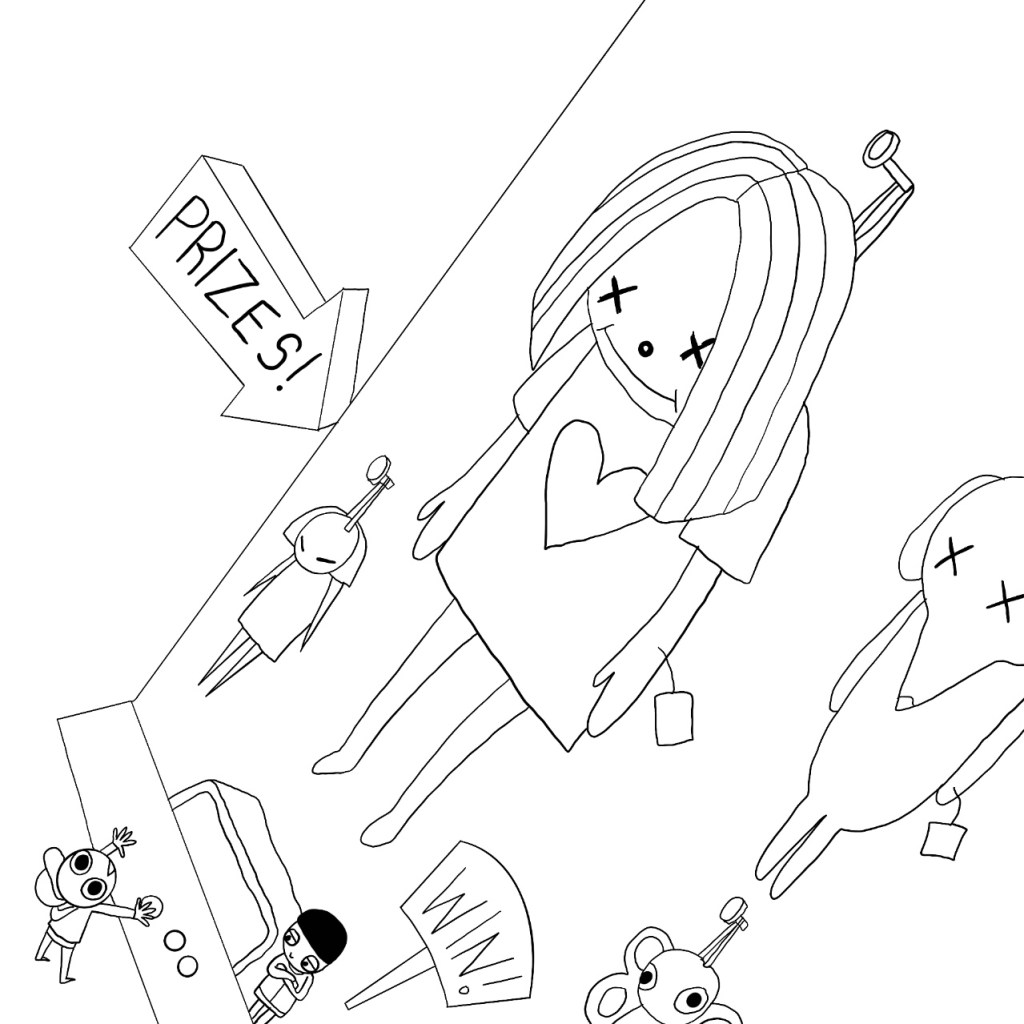
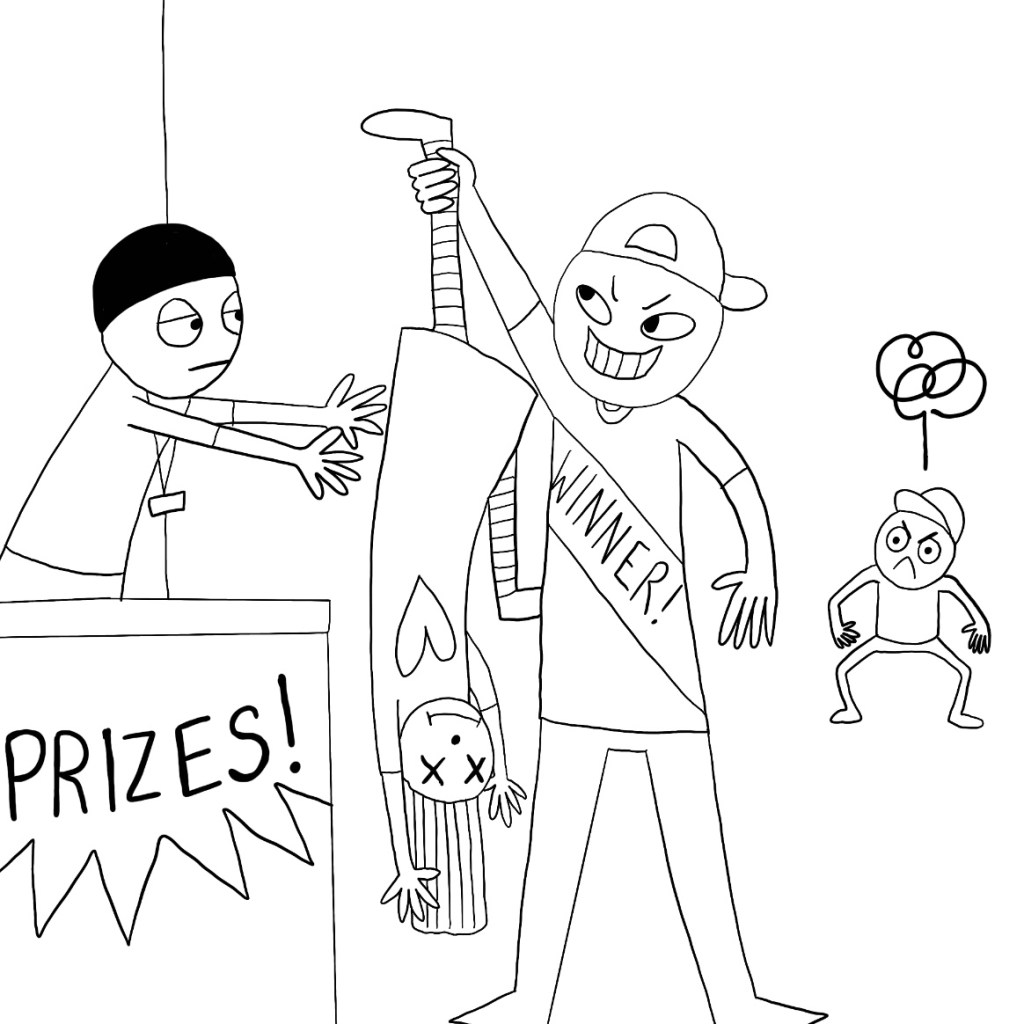
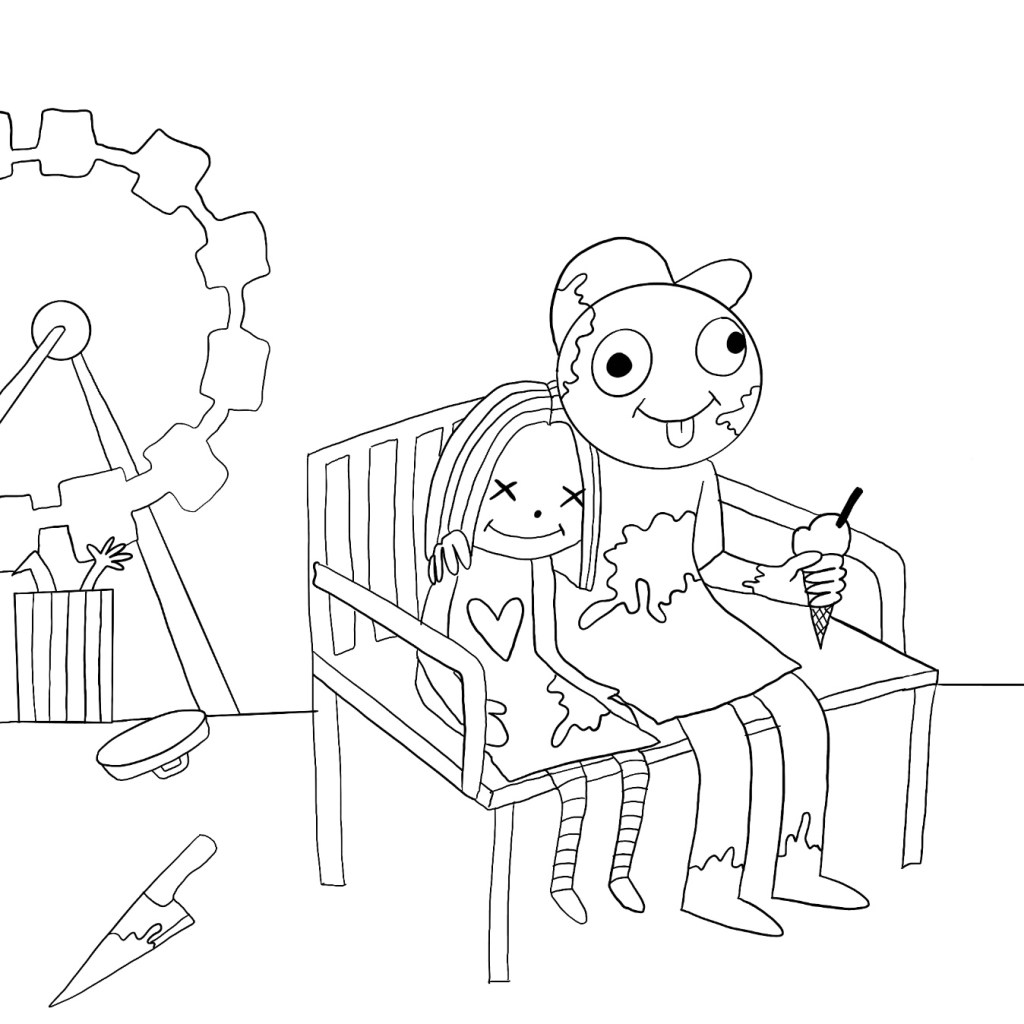

Colour:
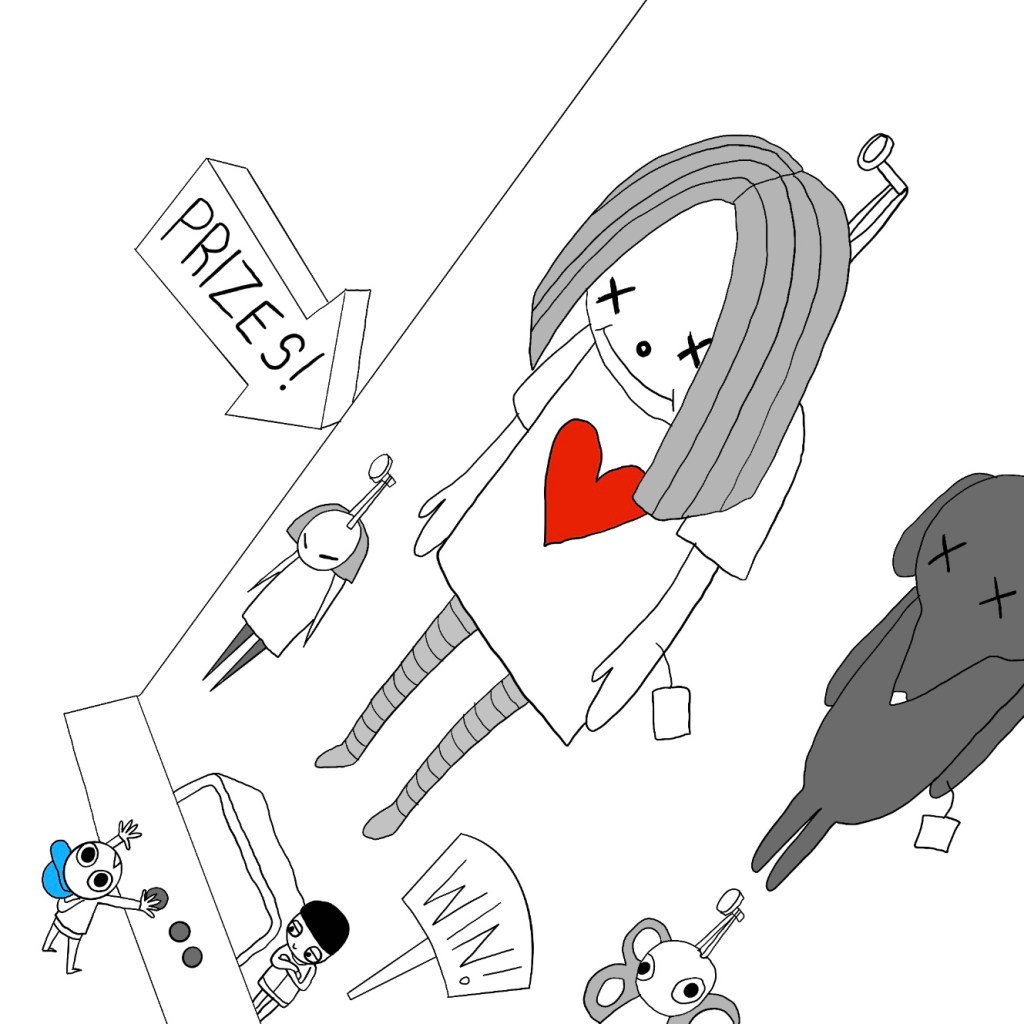
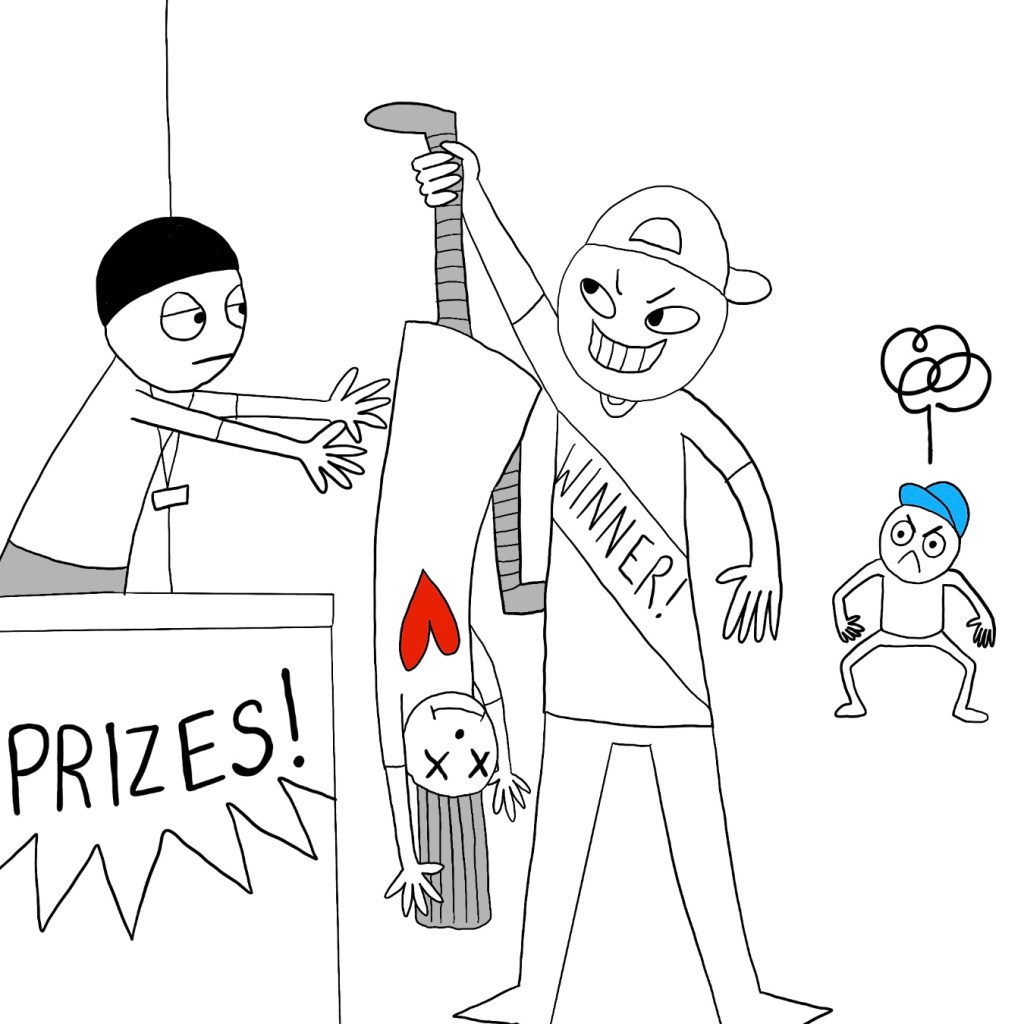
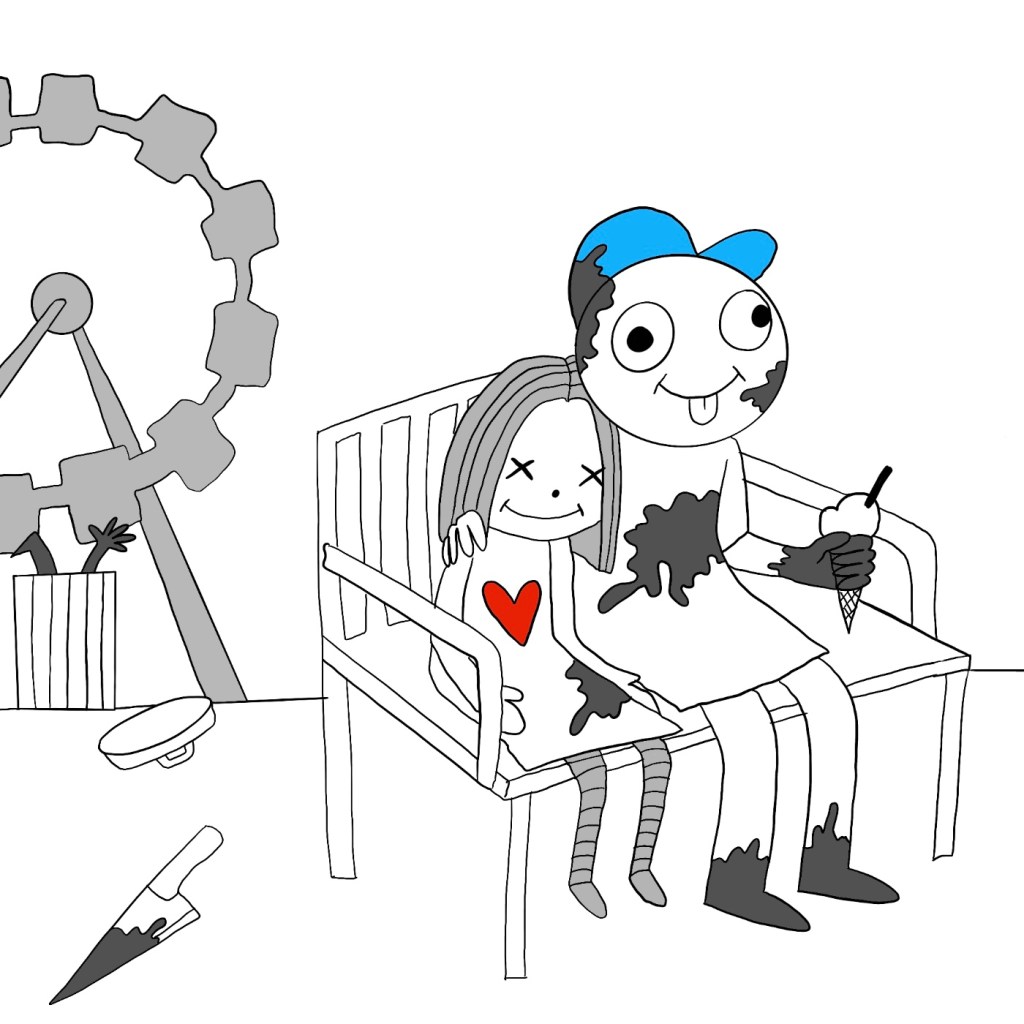
final design:
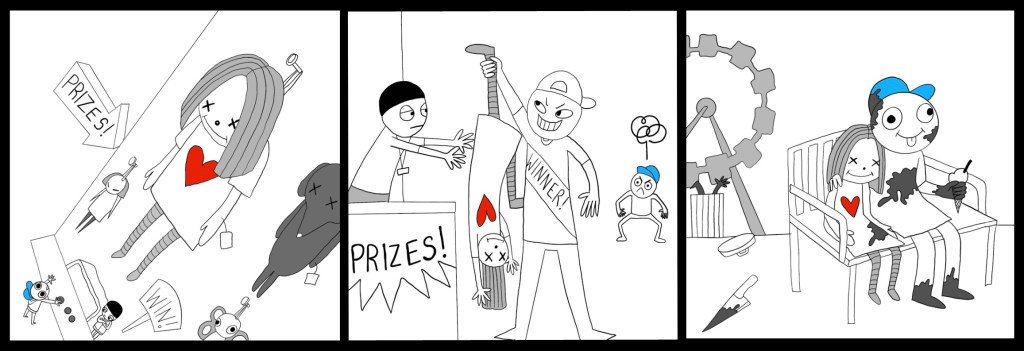
Evaluation:
I wanted to try to show the story of boy meets girl. boy loses girl, boy wins girl back in the most unique way possible so I thought about instead of doing the usual love story response to this brief, I would try doing the opposite. There is still an element of love in this story but just told in a different slightly-creepy way. The boy is treating the girl in a way that is more possessive than loving, although the girl is a toy that he’s won at the fair.
I wanted to focus on interesting angles and explain the story as clearly as I could so I did this by deciding to only highlight specific elements within the three panels, these included the heart on the girl and the hat on the boy. This way you can spot they characters even if they are far away like in panel two, it could have been confused by the other boy wearing a cap if I hadn’t incorporated colour. Other elements I filled using greyscale, this way those elements wouldn’t be taking the focus off the boy and girl.
 OCA Learning Log