
I would like to start this section by saying how glad I am that the subject of animation was included on this unit. I am very excited to start this section as I wish to continue with animation in the future.
Animation gives the artist an opportunity to tell a story (narrative) through the use of moving image, sometimes this is also paired with sound although a lot of the time you do not even need sound to tell a story through animation.
Research Task 1:
For this research task I have bee asked to research into Athanasius Kircher’s magic lantern and ask myself how animation has maintained this connection with the idea of the ‘illusion’.
Magic Lanterns:
Magic lanterns were an early type of projector where small slides of glass that had been painted on were inserted into a slot, a light source was then activated and the image was lit onto the surface (wall).
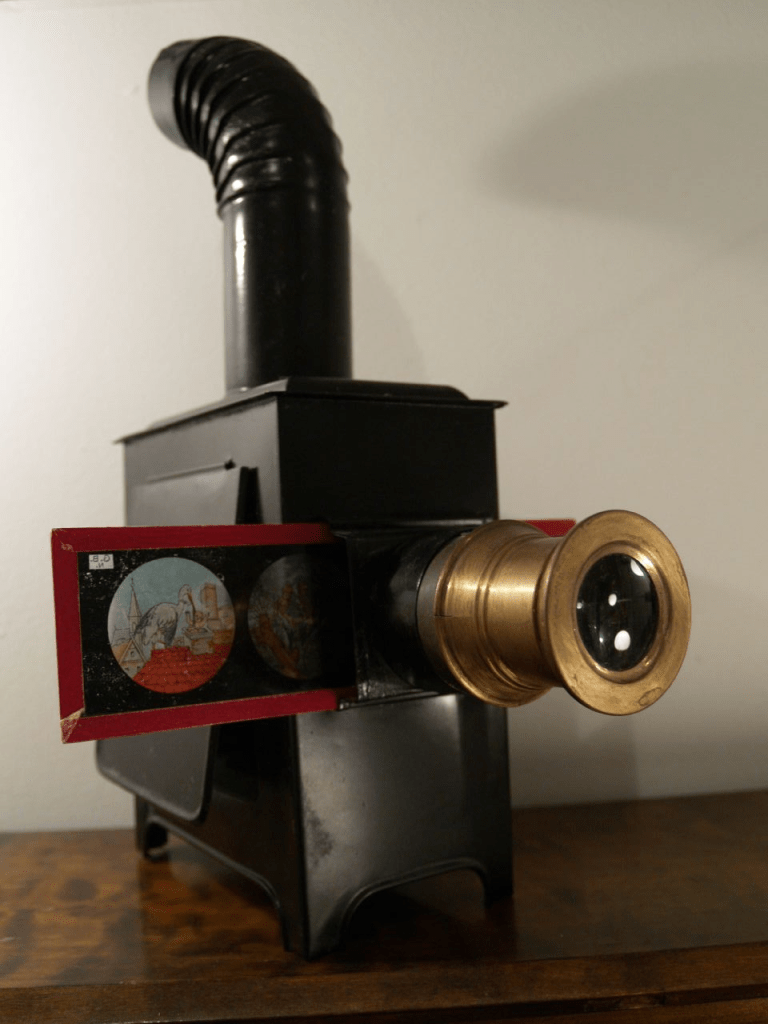
In 1645 Athanasius Kircher invented the “Steganographic Mirror”: a primitive projector with a focusing lens and text or pictures painted on a mirror, the light source was sunlight.

Magic lanterns were used at the time as a form of entertainment, people would gather in a room to watch the slideshow.
The below video explains how it works:
The first ever photograph was created in 1826, but the use of photographs in magic lanterns started in the 1840s. These would be the earliest form of photo projection or slideshow projection.
How animation has maintained this connection with the idea of the ‘illusion’:
From the start of it’s creation, animation has been used for entertainment purposes and sometimes in non-entertainment purposes for instance to visualise ideas at work. When I think about illusion as part of animation, frame by frame animation creating the sense of movement comes to mind. I am still in favour of traditional animation but as animation progresses so does the medium. Nowadays the preferred medium of animation is CGI. The ‘illusion’ has stuck all the way though.
For this question I decided to answer it in two different ways.
CGI Illusion:
A good example of animation being used for illusion is the film Avatar (2009). They used photorealistic computer-generated characters, created using motion capture animation technology and they also designed a camera built into a 6-inch boom that allowed the facial expressions of the actors to be captured and digitally recorded for the animators to use. I’d say overlaying an actors face on top of a computer-generated body is an illusion.

The Disney Illusion:
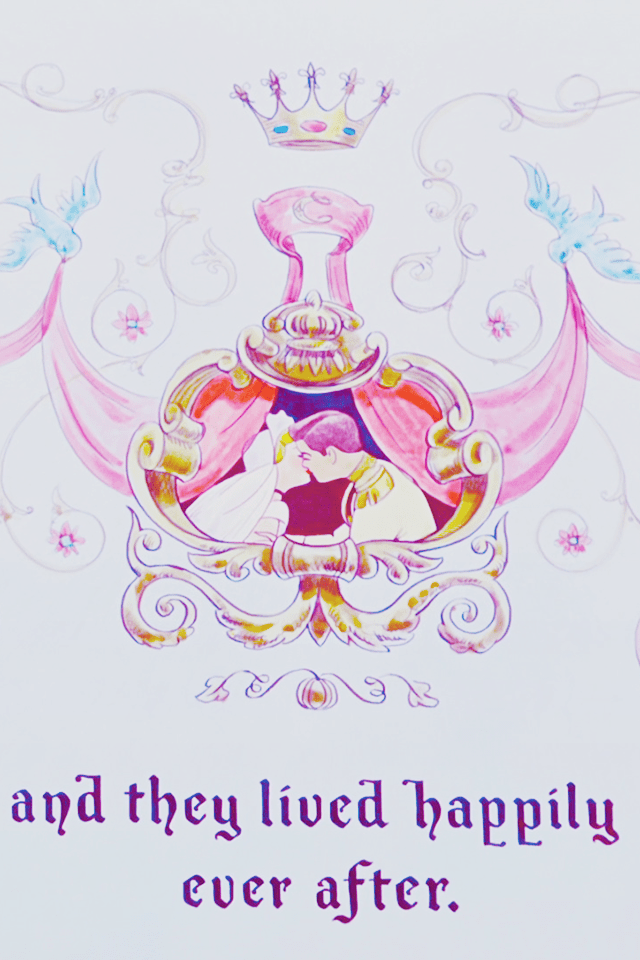
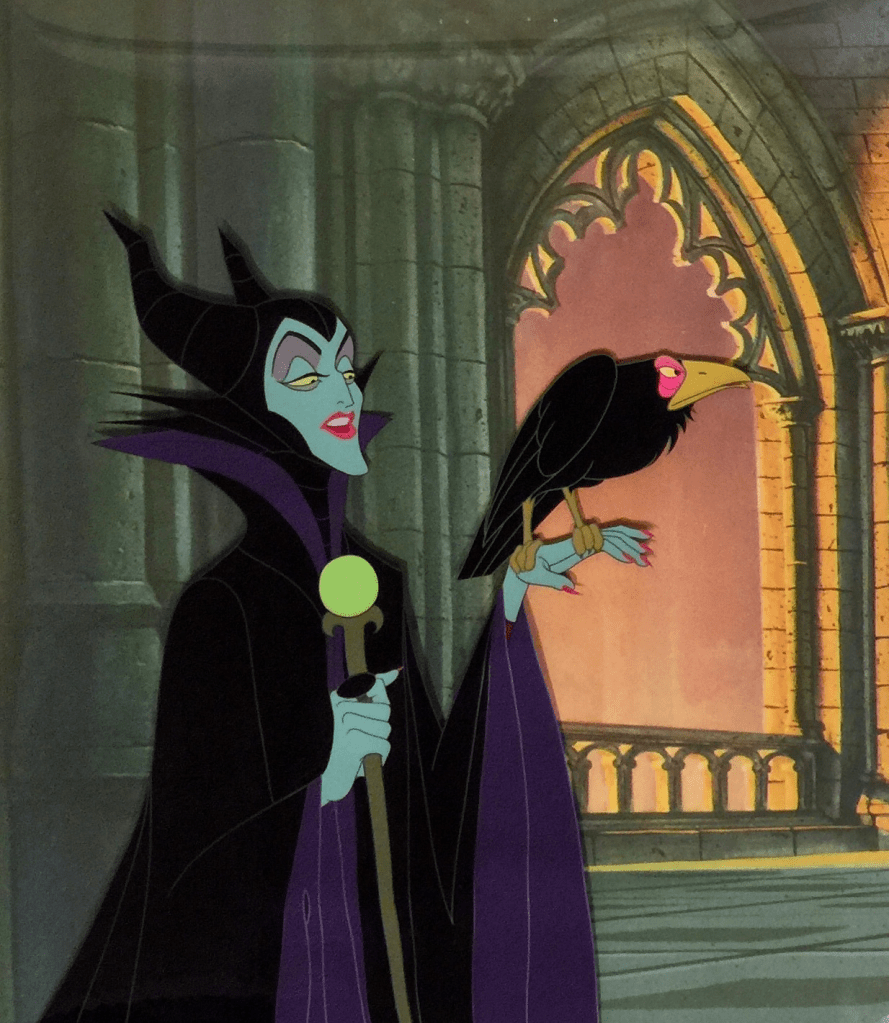
I think Disney has always had this vision of ‘magic’ throughout their films from the start with their full-length feature film ‘Snow White and the Seven Dwarfs’ in 1937 to ‘Wish’ the upcoming Disney film coming in 2023. It will be the 62nd Disney film. All the films are filled with magic, dreams coming true and wishes being granted, most children and adults have always lived by these philosophies ad sometimes these ideologies can be comforting, although in my eyes these are illusions, for instance finding your ‘prince charming’ and ‘living happily ever after’ and then when this doesn’t happen to you, you ask people ‘what about MY happily ever after?’ This is because ‘happily ever after’ is a fantasy developed by Disney. You will also see specific characters who would rather not be in a relationship, look different (not like a princess) and live alone, these are the witches or evil characters by default. I think this says a lot about how they visualise strong women.
Research Task 2:
There are a few ways to animate: Flat animation, Model-Making, Flash Animation and CGI.
Below I have decided to show some examples of the basic animation types:
1 – Flat Animation:
Cutout Animation:
South Park originally animated by Trey Parker & Matt Stone, later becoming computer animated.
“Cutout animation is a form of stop-motion animation using flat characters, props and backgrounds cut from materials such as paper, card, stiff fabric or photographs. The props would be cut out and used as puppets for stop motion”.
Wikipedia
Cell animation:
Old Disney Films or most recently one particular scene in Steven Universe – both animated by James Baxter
“A cel, short for celluloid, is a transparent sheet on which objects are drawn or painted for traditional, hand-drawn animation”. “Generally, the characters are drawn on cels and laid over a static background drawing. This reduces the number of times an image has to be redrawn and enables studios to split up the production process to different specialised teams”.
Wikipedia
2 – Model-Making:
‘Pingu’ animated by Otmar Gutmann and Erika Brueggemann
“Model animation is a form of stop motion animation designed to merge with live-action footage to create the illusion of a real-world fantasy sequence”. “Clay Models: Unlike most clay figures used for animation, clay models have an inner metal skeleton designed to allow them realistic movements and expressions”.
Wikipedia
The Nightmare before Christmas directed by Henry Selick and produced and conceived by Tim Burton
Wallace and Gromit animated by Nick Park and Aardman Animations
3 – Flash Animation:
The Ricky Gervais Show
“Adobe Flash is able to integrate bitmaps and other raster-based art, as well as video, though most Adobe Flash films are created using only vector-based drawings, which often result in a somewhat clean graphic appearance”.
Wikipedia
4 – CGI:
The Incredibles
“Computer animation is the process used for digitally generating animations”. “Computer animation is essentially a digital successor to stop motion techniques, but using models and traditional animation techniques using frame-by-frame animation illustrations. Also computer-generated animations allow a single graphic artist to produce such content without using actors, expensive set pieces, or props”.
Wikipedia
Brave:
WALL-E:
Almost all of the PIXAR films use CGI – they created films using Renderman (a 3D rendering software)
Below is an example of animators being inventive with the technological limitations they have available to them:
Sledgehammer by Peter Gabriel: Claymation, pixilation, and stop motion animation provided by Aardman Animations and the Brothers Quay. In 1986 animation was all the rage in Music videos as it was a relatively cheap but great was to create a unique and eye catching video that goes with your music.
Below is an example example of animators pushing the boundaries and finding new ways of working:
3D zoetropes by Kevin Holmes: zoetropes create animations that look like real moving sculptures. These zoetropes have been around for a long time with the most well known one depicting a man riding a horse. This one below though is very different in comparison, for starters it’s created using 3D models and they have been created using 3D computer software, creating a smooth 3D animation in real life.
Exercise 1: Flick-books and animated GIFs
This exercise asks for me to create some basic flick-book, QuickTime or animated gif animations that involve chases, shoot-outs, or any other staple of the action film, loosely playing within the genre of action movies.
For these animations I will be using the programs Procreate and OpenToonz, I enjoy animating on both.
Animation idea 1:
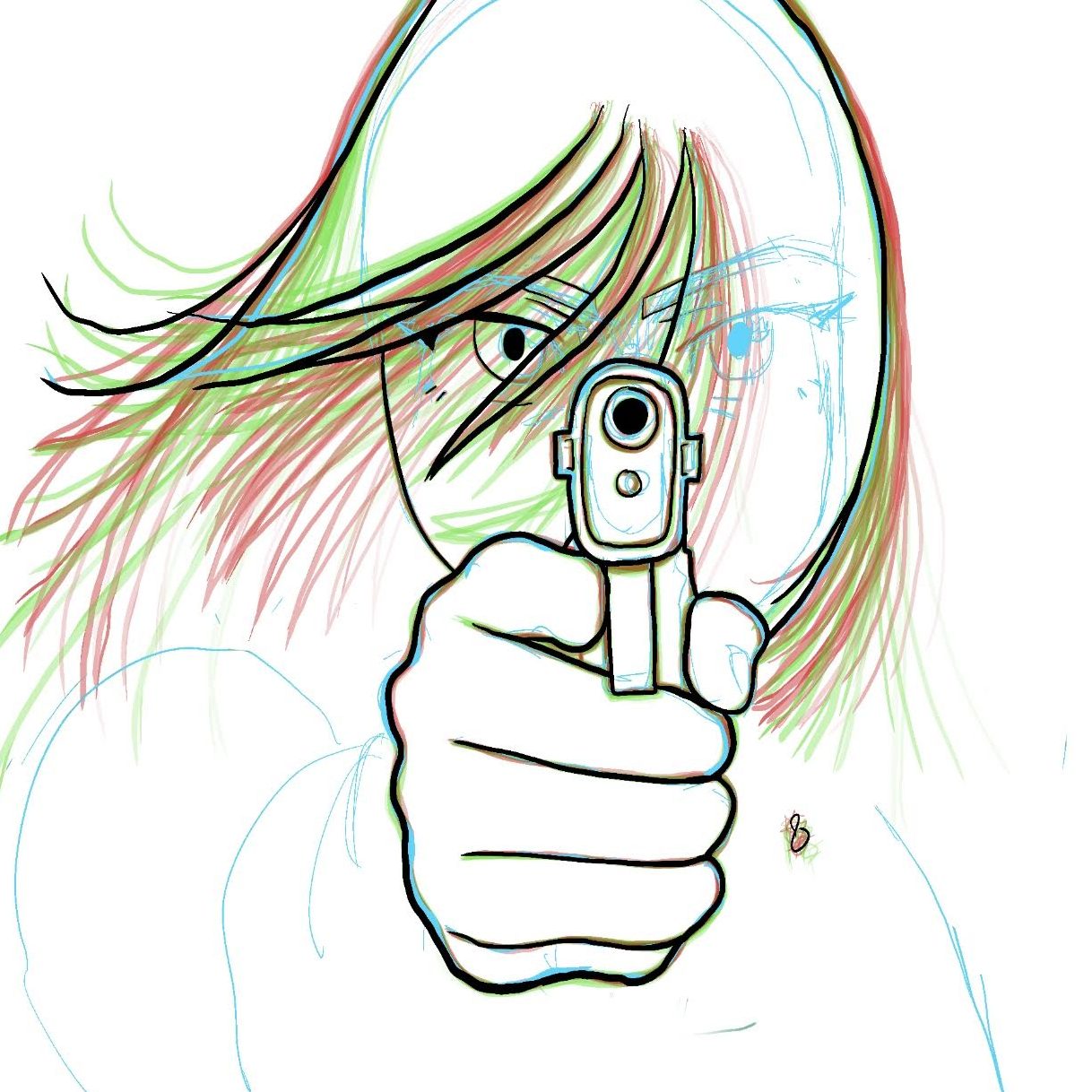
Woman with hair blowing in wind staring down the barrel of a gun.
Process of creating animation:
Final animation:
Animation idea 2:
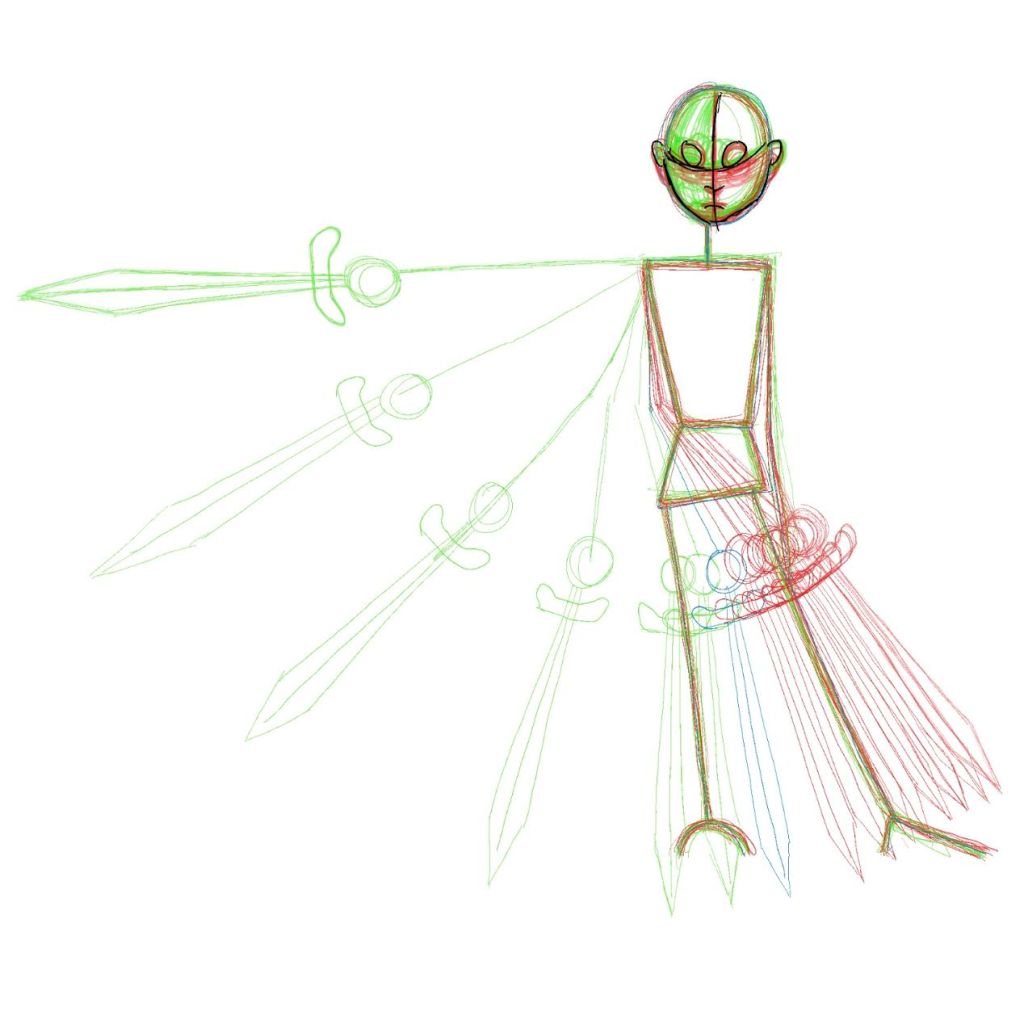
Man holds up and swings sword.
Process of creating animation:
Final animation:
Animation idea 3:
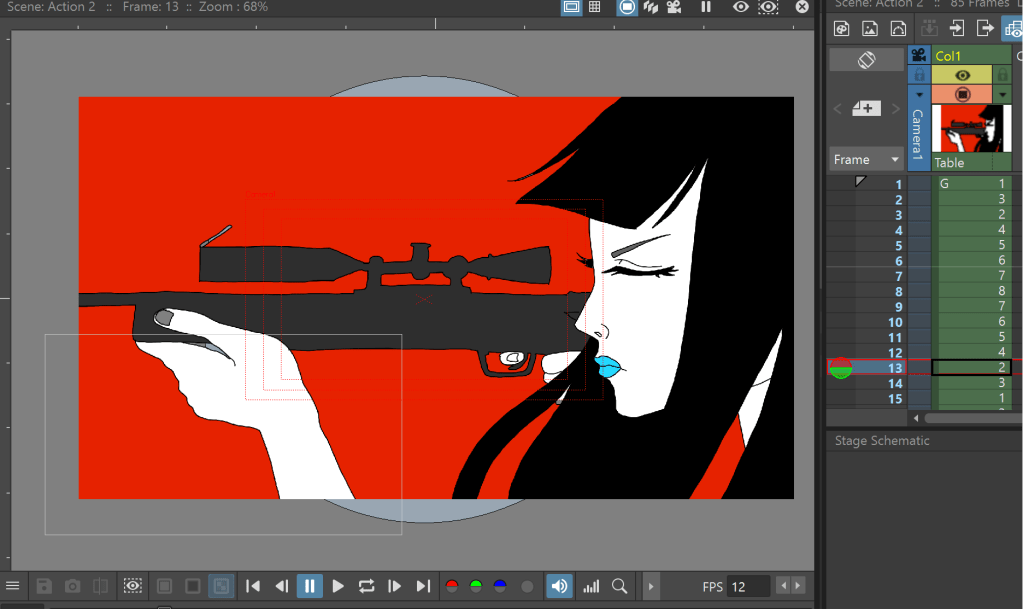
Person holds gun against other person’s head with hand over their mouth.
Process of creating animation:
Final animation:
This exercise was really exciting and fun. It gave me a chance to show my love for animation. Of course I am in still in my infancy when it comes to animation but I do love it and want to progress in it. I feel as though these three small looped animations are really expressive and each of them is different. I showed 2 using a gun and 1 using a sword as all three are staples of action films. I animating with onion skins on interesting as you can see just how many frames I have to use in order to create movement.
The first 2 were created using Procreate which is why the onion skins look the same and the format is the same 1X1. The 3rd one was created using OpenToonz which is why it looks more professional and less sketchy. Strangely enough Procreate was a paid app and I have to use my iPad and Apple Pencil to animate but the more professionals OpenToonz is completely free, I have to use my Wacom to draw through my laptop.
Exercise 2: Animal farm
For this exercise I need to develop an anthropomorphic animal character that is capable of showing a range of
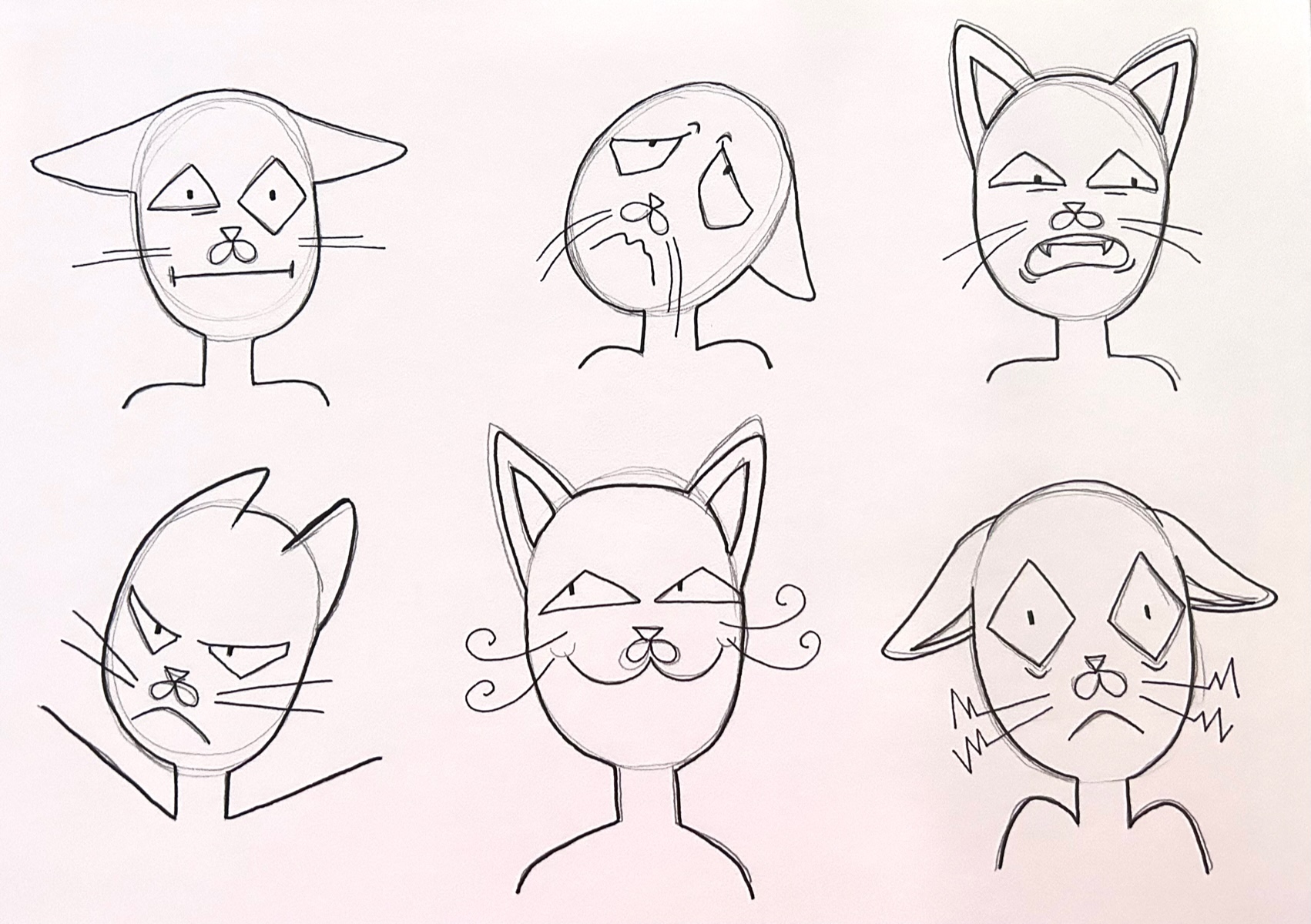
emotions, movements and reactions to different situations. I need to come up with extreme examples of the emotions.
I will develop a range of drawings showing my character from different angles, with different expressions and in different poses.
character idea:
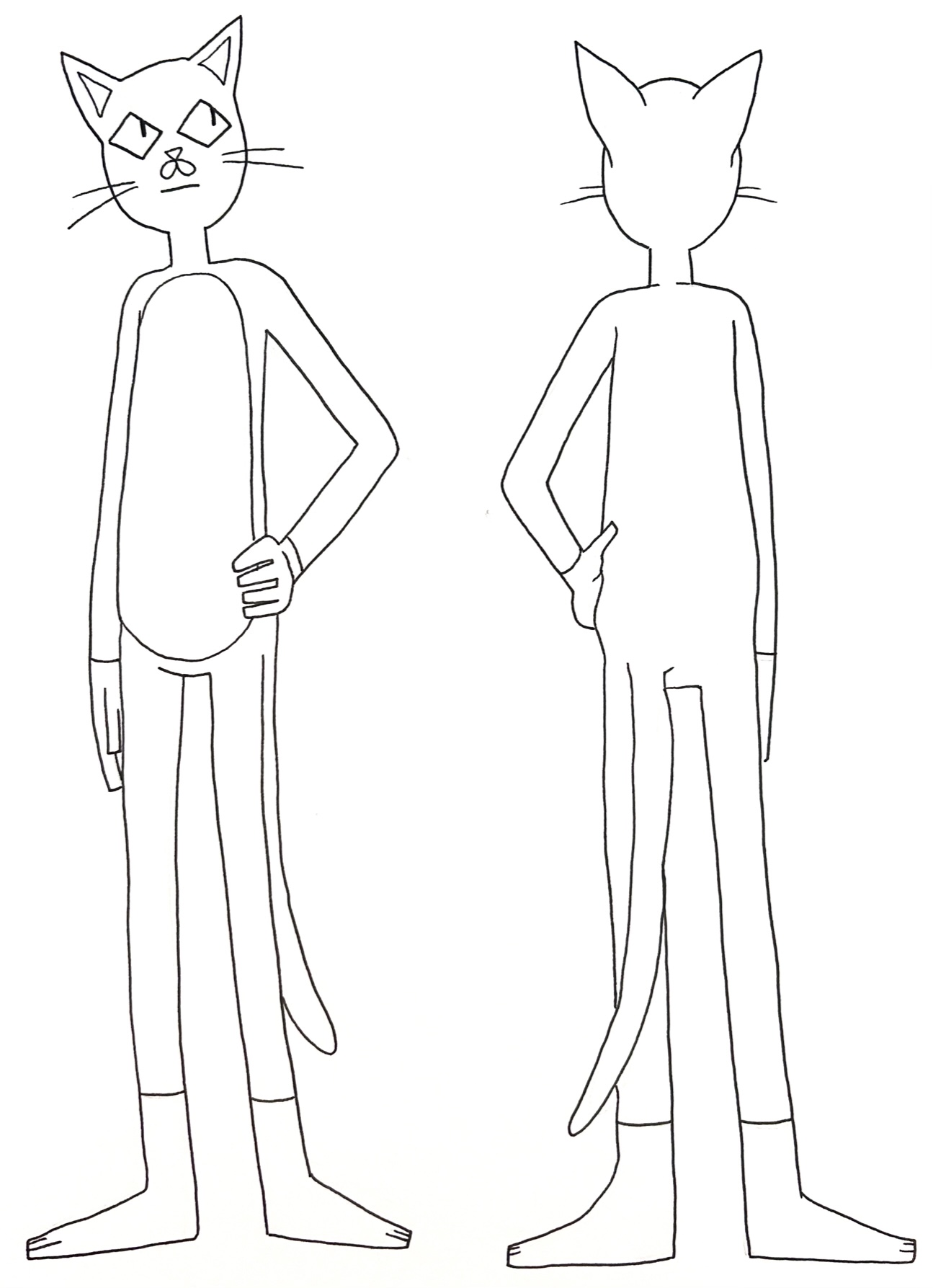
I will be drawing an anthropomorphic cat, I chose to base my design on my late cat Momo as he had a quirky and human-like personality and an awesome moustache.

Character idea sketching:

Initial character sketch:

Character face emotion movements:



Character body movement poses:


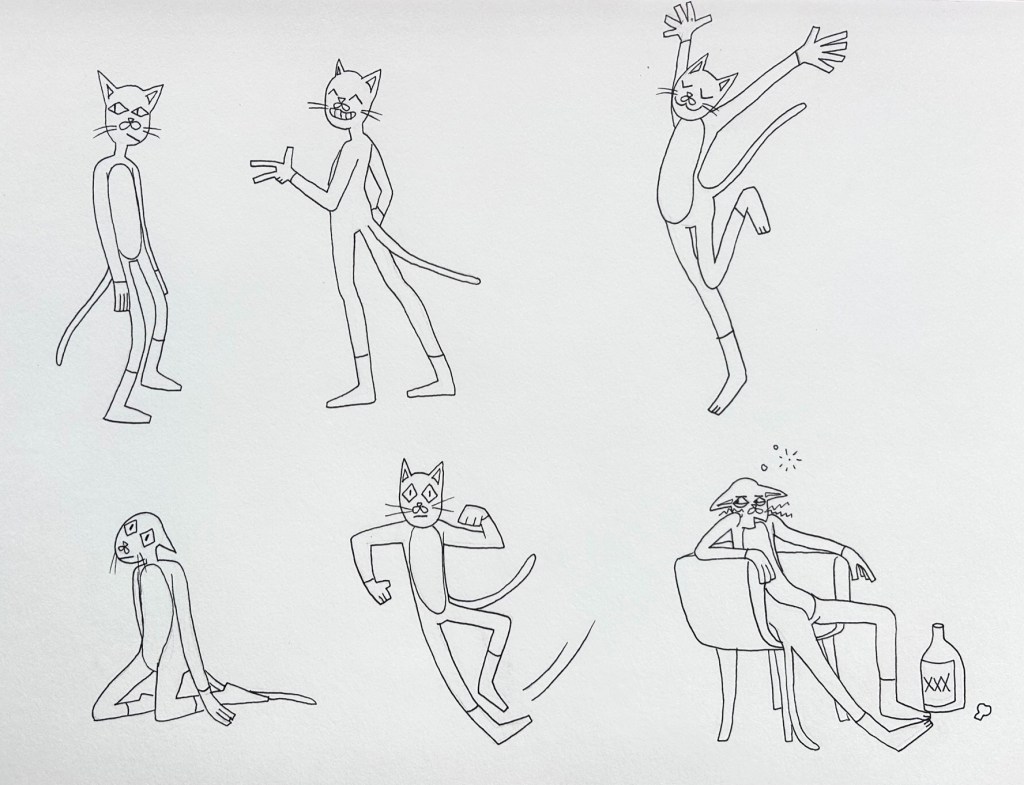
I enjoyed this exercise so much, It was great to turn my late-cat into a human. I’ve shown my design process for this exercise through my sketches, line drawings and initial ideas. I feel as though my illustrations show a good variety of emotions and movements. Some poses are comical / positive and some show negative emotions such as despair. I wanted to create a small animated loop showing ‘Momo’ influenced by the drunk pose in the image above. I animated this on OpenToonz.
Animated Loop of Momo:
References:
PIXAR : https://en.wikipedia.org/wiki/Pixar
Flash Animated Cartoon List: https://en.wikipedia.org/wiki/List_of_Flash_animated_television_series#:~:text=Property%20Value%20%20Name%20%20%20%20Network,%20Canada%2C%20United%20States%20%20%201996%20
Wallace & Gromit: https://en.wikipedia.org/wiki/Wallace_and_Gromit
Pingu: https://en.wikipedia.org/wiki/Pingu
The Nightmare before Christmas: https://en.wikipedia.org/wiki/The_Nightmare_Before_Christmas
South Park: https://en.wikipedia.org/wiki/South_Park
The Ricky Gervais Show: https://en.wikipedia.org/wiki/The_Ricky_Gervais_Show_(TV_series)
The Incredibles: https://en.wikipedia.org/wiki/The_Incredibles
Brave: https://en.wikipedia.org/wiki/Brave_(2012_film)
WALL-E: https://en.wikipedia.org/wiki/WALL-E
James Baxter: https://en.wikipedia.org/wiki/James_Baxter_(animator)
Cutout Animation: https://en.wikipedia.org/wiki/Cutout_animation
Cel Animation: https://en.wikipedia.org/wiki/Cel
Model Animation: https://en.wikipedia.org/wiki/Model_animation
Flash Animation: https://en.wikipedia.org/wiki/Flash_animation
CGI: https://en.wikipedia.org/wiki/Computer_animation
Magic Lantern: https://en.wikipedia.org/wiki/Magic_lantern
 OCA Learning Log